

By Jen Saarbach & Kristen Kelly, Co-Founders of The Wall Street Skinny
Yesterday, the U.S. Court of International Trade shocked the markets by attempting to curtail some of the more extreme aspects of President Trump’s tariff plan.
The court ruled that the reciprocal tariffs announced on “Liberation Day”, which were imposed under a previously little-known 1977 U.S. federal law called the International Emergency Economic Powers Act (IEEPA), are unlawful.
The law does allow the President to freeze assets, block financial transactions, or impose trade restrictions where there is an unusual or extraordinary threat to the United States.
However, according to the Court’s interpretation, the IEEPA does not grant the president authority to unilaterally impose broad tariffs on goods purely for economic protectionism or trade disputes.
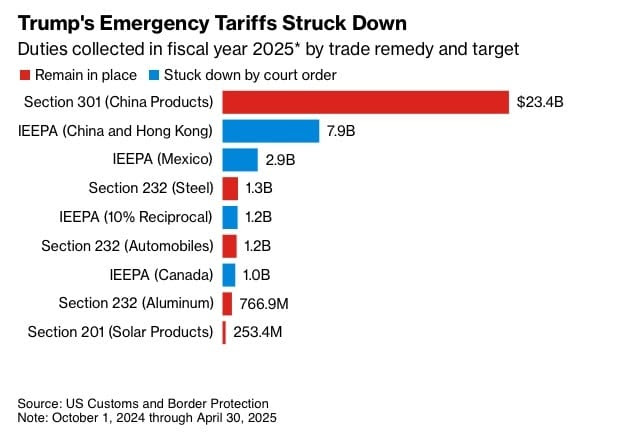
If upheld, this decision would invalidate most of the tariffs announced in April, namely the baseline 10% tariff applied to nearly all imports and the additional “reciprocal” tariffs imposed on the list of 60 of our largest trade partners.
However, this ruling does not impact earlier tariffs imposed under legal authority outside of the IEEPA, such as the tariffs on steel and aluminum, or those imposed on China originating in Trump’s first term. Bloomberg has a great chart breaking this all down:
Market Reaction: TACO Euphoria
Risk assets responded quite positively to the news, with equity futures trading up on the announcement. Markets were perhaps already predisposed to react positively, given the prevalence of our new favorite acronym: the “TACO” trade.
“TACO” is Wall Street’s latest acronym, short for “Trump Always Chickens Out”, meaning, smart money fades any hawkishness from Trump on the tariff front. “New tariff announcement? Eh, he’ll probably back it down later, load up on S&Ps.”
When a reporter asked Trump if he agreed with the “TACO” sentiment yesterday, he reacted unfavorably, calling it a “nasty question.”
Lingering Questions and Uncertainties
The administration has already announced plans to appeal the decision, and the court’s ruling will likely have a big impact on the ongoing trade negotiations with our biggest trading partners. What happens, for example, to the preliminary trade agreement with the U.K.?
Moreover, the court has given the administration ten days, which is basically a millisecond on the government implementation time scale, to implement the reversal on the customs front. It’s unclear how that will actually go into effect.
Ultimately, the Trump administration already has a contentious relationship with several judges, and it seems likely that we see increased friction between the Executive branch and the courts going forward.