

By Jen Saarbach & Kristen Kelly, Co-Founders of The Wall Street Skinny

Why Paramount Buying Warner Brothers Isn’t Typical M&A
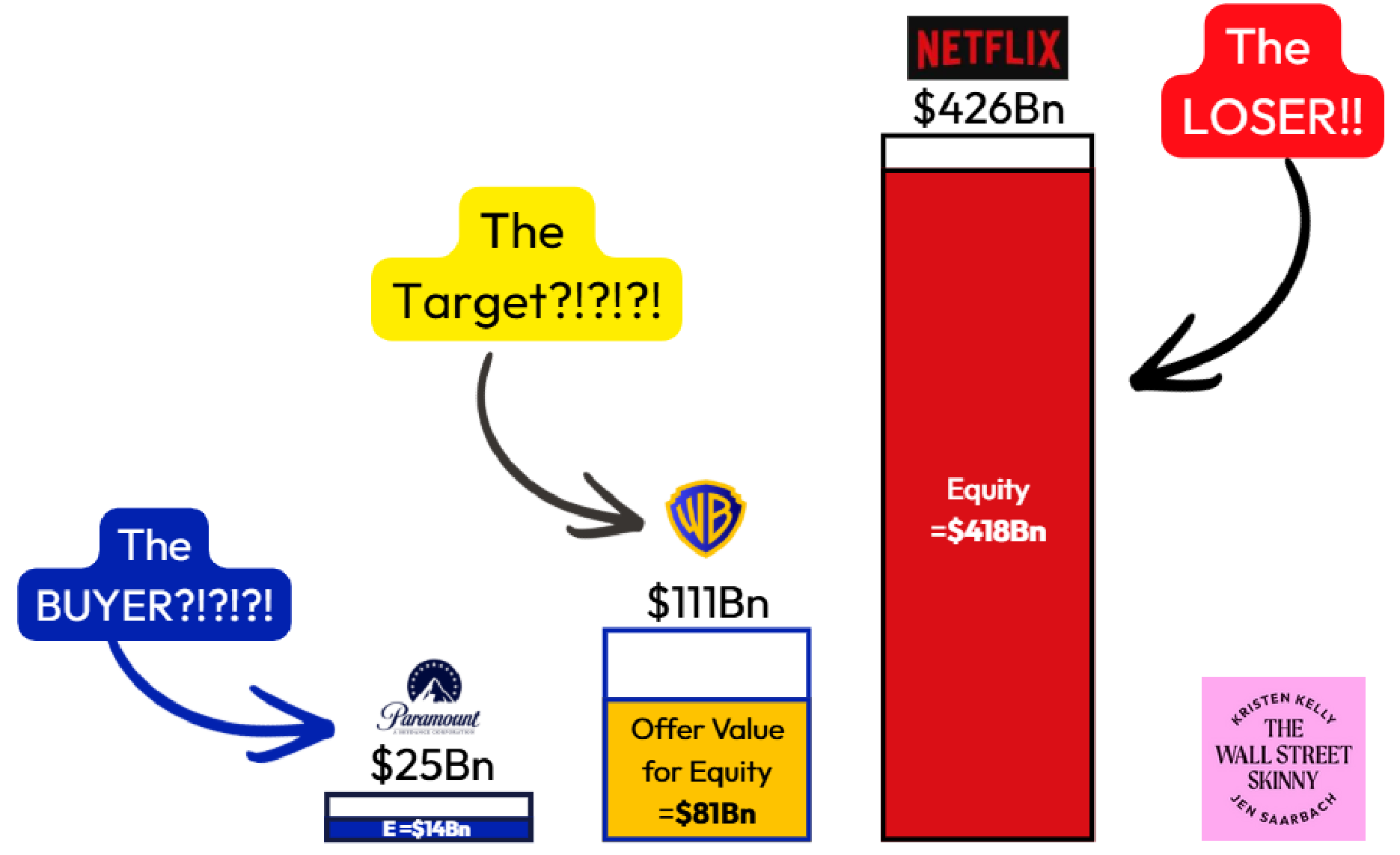
The insanity of the Paramount / Warner Brothers deal is best illustrated by the diagram below.
How can Paramount — a $25bn firm — offer to pay $111bn to buy Warner Brothers?
And how could they afford to pay MORE than Netflix, a company 17x their size?
The answer?
The same way private equity firms have been doing it for decades:
A leveraged buyout. And in fact, if this deal goes through, the Ellisons will be doing the largest LBO ever given the $111 billion price tag.
Now before we dive into the mechanics, and why the metrics Netflix is using aren’t the same as Paramount’s, let’s just stop to appreciate the sheer size relative to past deals.
The previous record holder for largest LBO was Electronic Arts, a $55 billion LBO in September 2025, done by PIF, Silver Lake, and Affinity Partners. We covered that HERE. Before that was TXU Energy in 2007 at $45 billion, and Musk’s Twitter at $44 billion. And before that, the legendary RJR Nabisco deal (the one that inspired Barbarians at the Gate) was $25 billion.
But the financial press isn’t calling it a leveraged buyout (LBO). They’re calling it a merger.
And yes, it technically is a merger. We have one public company Paramount (PSKY) merging with another public company, Warner Bros (WBD), where PSKY shareholders will continue to hold their stock in the combined entity.
But the mechanics of this transaction are indistinguishable from a private equity–style LBO. How so?
Paramount — worth $25bn with $14bn of existing equity — can’t swallow a $111bn company alone. Unlike traditional M&A where the buyer is LARGER than the TARGET, the buyer either raises debt or issues new shares to fund the entire acquisition.
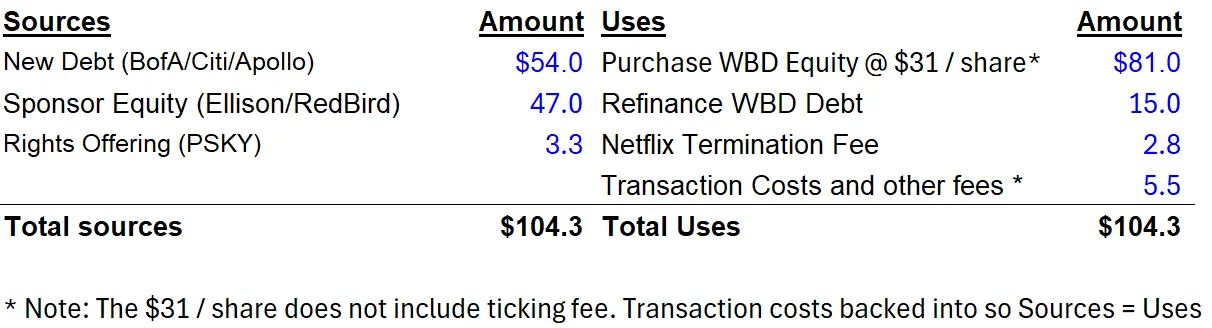
That’s not what’s happening here. The CEO, David Ellison, happens to be the son of Oracle billionaire Larry Ellison. And so the Ellisons + RedBird Capital are putting in an additional $47bn of equity and borrowing $54 billion from the banks, backed mostly by the cashflows Warner Brothers will generate. Sure, there is a $3.25 billion rights offering as part of this deal, where existing PSKY investors can buy in, but $3bn is peanuts relative to the $111bn price tag.
That’s a classic LBO. (Short explainer on what an LBO is HERE). For fun, we build out the Sources & Uses table for the transaction. Not seen is the PSKY rollover equity which is just along for the ride (and should show up on both the sources and uses). You can watch our original video on this with the OG numbers HERE.
Now the press release also stated there “may include other strategic and financial partners at closing”. Earlier iterations of the bid included sovereign wealth funds like Saudi Arabia’s PIF (part of the EA deal), Abu Dhabi’s L’imad, and Qatar’s QIA as co-investors.
Technically these funds weren’t named in the most recent press release likely given the political backlash their involvement generated last time around. But when Matt Belloni pressed RedBird’s Gerry Cardinale on The Town this past week about whether they’re still in, Cardinale didn’t deny it. He also wouldn’t comment on whether they would get a board seat. It’s worth noting, Jared Kushner’s Affinity Partners and China’s Tencent, which were part of earlier bid iterations, have dropped out.
Why Don’t Public Companies Usually Do LBOs?
First, typically buyers don’t need to do this because they’re larger than the target. But the other part is public companies don’t typically like to take out massive amount of debt (measured by leverage, more on that below). as tons of debt means lots of interest, which crush EPS.
EPS is the main metric public companies focus on because it’s the metric most equity investors trade stocks off of. If EPS goes up, traders are willing to pay more for the stock. Public companies also live and die by how their earnings perform quarter to quarter, and huge amounts of leverage and interest expense make for high volatility in EPS.
Private equity firms who do LBOs (like KKR and Blackstone) are different. They’re buying businesses they expect to hold for 5-7 years. They don’t think much about Net Income (seen as an accounting metric), and don’t care much about how the company performs quarter-to-quarter. Instead, they look long term and focus on cash flow generation which ultimately helps them support a higher valuation when they sell and allows them to pay down the debt.
The Ellisons can do a deal like this with tons of debt like a private equity firm because they also aren’t focused on short term Net Income or EPS performance (remember EPS = Net Income / Shares). While they’re a public company, they aren’t at the whims of their public equity investors.
Why not?!
PSKY has a dual-class share structure where the Ellison family and RedBird hold 100% of the voting rights through Class A shares. The public Class B shares (ticker PSKY) are non-voting. David Ellison has 50% of the vote, Larry has 27.5%, RedBird has 22.5%. Public shareholders have zero say…they get economics. Additionally of the ~$14 billion market cap, roughly 70% of the Class B float is held by Ellison-affiliated entities and RedBird. The legacy Paramount public shareholders, the true “outsiders”, hold only about 30% of Class B shares, which is only roughly $4–4.5 billion of equity relative to the $14bn.
“Okay,” you might say, “but both Netflix and PSKY were offering to do all-cash deals funded by debt. So why is the amount of debt being taken on wild for PSKY, but not for Netflix?”
Debt is talked about as a multiple of EBITDA – i.e., Leverage = Debt / EBITDA. EBITDA is the standard proxy for operating cash flow. Since it’s operating, it’s operating income before financing. It’s literally in the name: earnings BEFORE INTEREST, taxes, depreciation and amortization. And the leverage multiple tells you roughly how many years of cash flow it would take to pay down the debt. The ceiling for most banks these days in terms of how much they’ll lend is about 6 – 7x.
Netflix generates over $13 billion in EBITDA on its own so had they done the acquisition, the WBD studio/streaming business would have added another $4–5 billion which means the combined entity would have produced roughly $18 billion in pro forma EBITDA. Moody’s estimated pro forma leverage would have been approximately 3.7x and affirmed Netflix’s investment-grade rating. The exact number likely includes some normalizations and add-backs we haven’t factored in, but the point stands: Netflix was pushing the ceiling of what investment grade could support, which is another reason they likely didn’t want to bid any higher — in addition to the accretion / dilution considerations we discussed in our last newsletter article.
It’s worth noting that investment-grade public companies generally work hard to stay investment grade, whereas private equity firms doing LBOs don’t particularly care if their debt is rated “high yield” or “speculative grade” by the rating agencies. In our day we just called it “junk.”
Paramount doesn’t appear concerned about a downgrade either. The company was already teetering on the edge before announcing the deal, with standalone leverage around 3.9x. Once leverage moves above roughly 4x, rating agencies often begin to reassess investment-grade ratings for companies with otherwise stable businesses. Following the deal announcement, Fitch downgraded PSKY from BBB- to BB+ (junk), while Moody’s and S&P both placed the company on review for potential downgrades.
Not surprising given that, on a pro forma LTM basis, PSKY-WBD’s leverage has been quoted to land around 6.5–7.0x on day one before synergies. Here is the math based on what we were able to pull from public disclosure.
Pro Forma Debt ~ $86 billion
Pro Forma LTM EBITDA (WBD at 8.7B+PSKYnormalizedat~3B) ~ $11.7 billion.
86 / 11.7 > 7.0x leverage.
“But wait,” you say…the Paramount press release claims:
“At closing, we expect to have a net debt-to-EBITDA of 4.3x on a synergized basis, with a clear path to investment grade credit metrics within three years of closing.”
4.3x…um what now?
The Leverage Picture: 4.3x or 7.0x?
The company is quoting 4.3x net debt-to-EBITDA. That number backs into roughly $19 billion in combined pro forma EBITDA: WBD’s $8.7 billion plus PSKY’s guided $3.8 billion for 2026 (so these are expected numbers vs. actual Last Twelve Months, LTM), plus the FULL 6billionofexpectedsynergies.Andthey’reusingNetDebt(Debt-Cash)~82 billion of net debt, not Gross Debt (which is what lenders focus on).
But any M&A banker knows that is not consistent with industry norms. Here’s why.
A Peek Inside a Traditional M&A Model
When an investment bank builds a merger model, synergies don’t just show up on day one. Two concepts are critical:
Phase-In: Synergies take time to materialize. You can’t fire thousands of people the day the deal is announced or renegotiate every vendor contract overnight. The industry-standard assumption is a 3–4 year ramp: something like 25% in Year 1, 50% in Year 2, 75% in Year 3, and 100% run-rate by Year 4.
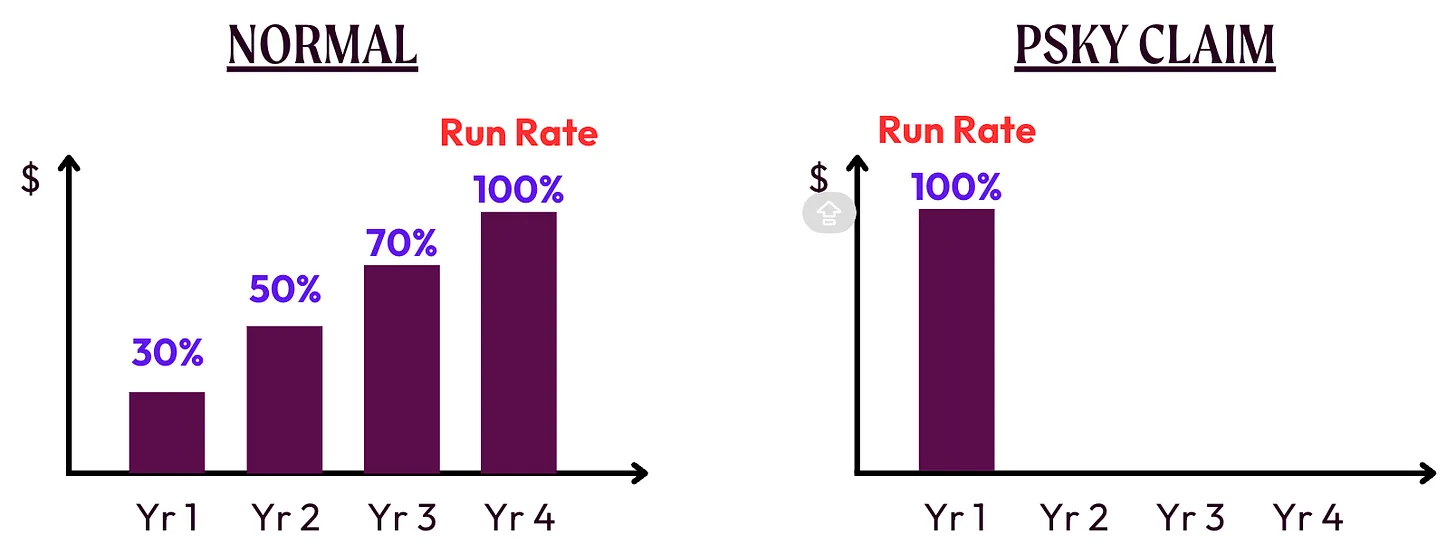
Merger Cost Outlays”: Getting synergies also isn’t free. Laying people off means severance. Consolidating offices means lease termination fees. Merging technology means migration costs, consultants, and system downtime. The rule of thumb is that cash outlays to achieve synergies are roughly 1x the annual synergy run-rate, spread over the first two years. So $6 billion in expected synergies means roughly $3 billion in cash outflows in each of Years 1 and 2.
The press release quoted the full $6 billion, so 100% of synergies in Year 1, with zero costs to achieve.
The reality is, for the people who matter — the lenders who are underwriting the deal — it would be VERY unlikely for them to give PSKY credit for unproven synergies. Therefore they are almost certainly underwriting the risk, the credit spread, and everything else off the “unsynergized number” – which is closer to 7x.
For context, investment-grade media companies typically operate at less than 3.5x. The company’s stated goal is to reach investment-grade within three years, which means getting down to roughly 3.0–3.5x. To bridge the gap from ~7x to ~3.5x, the combined company needs to pay down $10–20 billion of debt while simultaneously ramping synergies and growing EBITDA organically. That requires sustained free cash flow generation of $3–7 billion per year after content spending. It’s potentially achievable if the synergies materialize and linear TV doesn’t deteriorate faster than expected.
The Bigger Picture: The Ellison Empire
The thing about this deal is it doesn’t fit into an M&A or LBO box like you learn about in investment banking training.
It’s not traditional M&A – the buyer is a fraction of the size of the target. And it’s not a traditional LBO either, where PE firms typically evaluate feasibility by targeting a ~20% IRR. That requires some assumption about a sale and an ability to exit at a premium.
I don’t think the Ellisons are in this to sell in 5–7 years. So why are they doing it?
Honestly – not entirely clear. The closest comparison is Elon Musk’s purchase of Twitter. That was also an LBO of a business backed by a tech billionaire’s fortune (read: Tesla stock), also done for reasons that went beyond the financial math. In Elon’s case, Twitter was a rich source of data to feed his AI models at xAI. The banks that provided the ~$13 billion in LBO debt famously got stuck with it on their books when they couldn’t syndicate it – a cautionary tale for BofA, Citi, and Apollo as they prepare to place over $50 billion of debt.
The Ellisons appear to be running the same playbook. Or…
As NPR recently explored, what the Ellisons are assembling goes far beyond a single media merger. Consider the portfolio that is taking shape:
- Paramount Skydance: CBS, Paramount Pictures, Nickelodeon, MTV, BET, Comedy Central, Showtime, Paramount+, Pluto TV, and the Skydance film and animation studios.
- Warner Bros. Discovery (pending): HBO, CNN, Discovery, DC Comics, Warner Bros. Pictures, TNT, TBS, Cartoon Network, and Max.
- TikTok U.S. (15% stake via Oracle): Access to 170 million American users and one of the most powerful content algorithms ever built.
- Oracle: Cloud infrastructure, AI (including the $500 billion Project Stargate with OpenAI), government contracts, and the data backbone that ties it all together.
Just like Musk bought Twitter to feed xAI’s models, the Ellisons are assembling the largest content and behavioral data ecosystem in the world. A former Oracle executive told NPR that Ellison “may be looking primarily at the value of the data.” The combination of traditional media distribution (CBS, CNN, HBO), streaming platforms (Paramount+, Max), social media reach (TikTok), data infrastructure (Oracle), and AI compute (Project Stargate) is unprecedented.
WITH THAT SAID, there’s also a chance this is Veep not House of Cards.
Matt Belloni and Kara Swisher — two journalists who actually know the players and the space, and have no problem calling people out — both have said they don’t see this as Machiavellian. Rather this is a dad overpaying for a toy for his son. As Scott Galloway joked: this is a way for Larry Ellison to help buy his son a seat at the Oscars.
With that said, if anyone at HBO or Netflix is reading this…as Succession and Industry superfans, Jen and I are officially pitching this as Succession 2.0. If it’s made, we will be your OFFICIAL companion pod for the show. Or let us write the script. Consider this our formal inquiry.