

By Jen Saarbach & Kristen Kelly, Co-Founders of The Wall Street Skinny
While Jen was off living her best island life, there was a big development in the Netflix–Warner Bros. Discovery saga.
LAST WEEK, Netflix announced that they were planning to revise their bid for Warner Bros. Discovery, shifting from a mix of cash and stock to an all-cash offer. THIS WEEK on Tuesday, the day they announced earnings, they made it official.
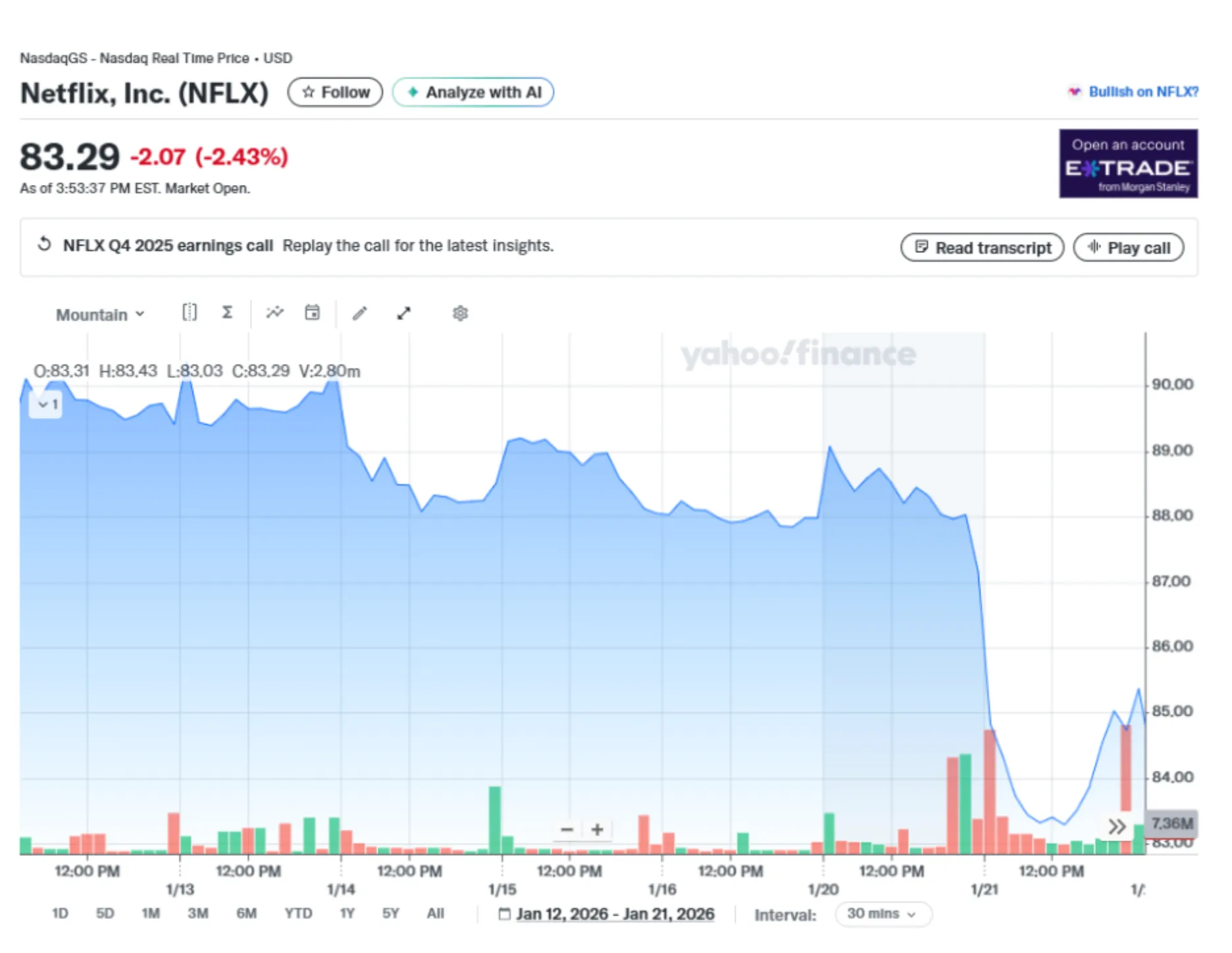
On the surface, that sounds like good news: less uncertainty, no stock dilution, and a cleaner deal. But the market hated it. Netflix shares sold off on the initial report last Wednesday Jan 14, and again after the confirmation Jan 20, the day they announced earnings, DESPITE mostly beating expectations.
[Image Caption: Netflix stock price]
Let’s unpack why investors reacted so negatively.
First, Netflix investors don’t love the deal. Even if they win, they have to get through anti-trust…which is not a done deal. Moreover, PSKY’s hostile bid is still outstanding and they may still increase their bid, which leaves some chance that Netflix will sweeten further. Not to mention even if they do win at this price, M&A is notorious for destroying shareholder value. In fact, Warner Brothers itself has been a cursed asset. Quite literally the poster child for the worst deal of all time is AOL / Time Warner which resulted in a $100 BILLION write down of goodwill within a few years of the acquisition…another story for another day.
But in the immediate term, making the switch to an all cash deal makes things WORSE for Netflix shareholders in terms of expected EPS. And all else equal, lower EPS means lower share price. Why?
Think about it in this rather simplistic way: PE = Stock price / EPS.
Said differently, Stock price = PE x EPS. Assuming a constant PE (big “if”, but still…), if EPS goes up, the share price goes up.
Ok, so why is this negative for EPS? Two reasons.
First, during their earnings call, Netflix announced they’re pausing share buybacks to help fund the deal. That’s negative for EPS, even without considering the Warner Bros. merger.
Why? Because earnings per share (EPS) is calculated as:
EPS = Net Income / Shares
When a company buys back its own shares, it reduces the number of shares in circulation. That boosts EPS, even if net income stays flat. Investors like this because it mathematically improves EPS.
So if analysts were modeling a decline in share count due to continued buybacks, and now that’s off the table, it means the denominator (shares) will stay higher than expected. EPS will drop vs. their expectations.
But on top of that, how the deal is financed plays a huge role in that EPS math, since using cash vs. stock are not equivalent in terms of their relative cost.
So which is more expensive? Let’s calculate it.
Cost of Stock: Netflix is trading at a P/E of ~37x. When companies issue shares to fund an acquisition, it increases the share count. To get a rough approximation of how much issuing shares “costs” in terms of EPS accretion/ dilution, we take the inverse of the P/E ratio. This means issuing stock has an implied cost of ~2.7% (1 ÷ 37).
Cost of Debt: Netflix doesn’t have $72bn sitting around, therefore they’ll fund a significant component of the cash consideration by raising debt. Let’s assume something like a 5.5% interest rate on that debt, which, after adjusting for a 25% tax shield, is a 4.125% after-tax cost.
So which is cheaper?
✔️ Stock at 2.7%
❌ Debt at 4.1%
Said differently: Netflix’s stock is a highly valuable acquisition currency. Issuing stock to fund the deal is more accretive to EPS than borrowing debt. So switching to all cash makes this deal more expensive and WORSE for shareholders of Netflix.
You can also look at this by instead comparing the relative PEs; their actual PE vs. PE of debt. Stock = 37x (P/E). PE of Debt = 1 / (cost of debt x (1 – tax rate) = ~24x implied P/E. The consideration with the higher P/E is more accretive.
So why didn’t the earnings win on Tuesday help? After all, Netflix reported EPS of $0.56 versus $0.55 expected, revenue of $12.05 billion versus $11.97 billion expected, and year-over-year revenue growth of about 18%. Solid results, and yet the stock still sold off around 6%.
That’s because markets care about future expectations, not past performance. Between management flagging potential growth headwinds, the cessation of share buybacks, increased certainty this deal will go through, and confirming an all-cash deal (which lowers future EPS), the outlook dimmed and spooked investors.
Looking ahead, the next chess move we’re watching for is Paramount sweetening its bid. Back in December, leaks suggested Paramount was running scenarios to raise its offer by around 10 percent. We haven’t seen that yet, but Netflix’s all-cash shift may force their hand.