

By Jen Saarbach & Kristen Kelly, Co-Founders of The Wall Street Skinny
From women who sat on Morgan Stanley’s CLO desk and Lehman’s trading floor in ’08…when it went bankrupt and took down the global economy,
If you read the headlines about Private Credit, it feels like we’re on the verge of another crisis.
So, are we?
As two women who started our careers in 2006 and 2007, one at Lehman Brothers and the other at Morgan Stanley in the CDO structuring group, we have a lot to say about whether what we’re seeing now bears any resemblance to what we saw then, and where things are better…or worse.
But before we can get there, let’s start with a review:
What is private credit? What’s the deal with these “gating” headlines? And what exactly is public about the quality of the underlying assets?
What Is Private Credit?
Private Credit is a catch-all term, but at its core it just means debt that isn’t traded in the public markets. Instead of a company going to a bank and getting a broadly syndicated loan — one that gets sliced up and sold to other banks and institutional investors — the company goes directly to a private credit fund. There’s one lender, or maybe a small handful, but it’s a directly negotiated deal.
The expansion of Private Credit has been a function of what happened in 2008. After the financial crisis, banks were ring-fenced and regulated so tightly that all the aggressive lending and risk-taking activity migrated outside of traditional banking institutions. What was initially called the “shadow banking industry” eventually got a facelift: Private Credit.
It gained traction in the zero interest rate environment post-COVID, when institutional investors went hunting for yield, and has gained tremendous traction in the past few years.
The pitch to borrowers was compelling as well: go to a direct lender and you can get deals done faster, negotiate with one counterparty instead of a syndicate, and avoid the public disclosure requirements that come with issuing bonds. Not to mention, many smaller companies couldn’t access the public credit markets given their size.
The trade-off? All else being equal, Private Credit is more expensive than bank debt. Borrowers pay interest rates that are often 100-150 basis points higher than they would pay in the broadly syndicated loan market, assuming they could even tap those markets in the first place.
For a certain set of institutional investors, the asset class was a no brainer. If you’re willing to lock your money up for (on average) 5 – 7 years, you’ll theoretically earn an illiquidity premium, which means a higher return as compensation for foregoing the ability to sell whenever you want.
And on top of that, many of these private credit funds also borrow money at the fund level. So if investors put in $100, the fund goes out and borrows another $100, and then deploys $200 worth of loans. You’re not just earning an illiquidity premium, but you’re also getting extra juice from leverage.
For a long time, the vast majority of money flowing into these funds came from institutional investors, like Harvard’s endowment, the Canadian Pension Plan Investment Board, insurance companies, sovereign wealth funds, other hedge funds, etc. What do they have in common? They’re all sophisticated players with long investment horizons who tend to understand the risks, and who can (in theory) withstand market volatility.
Then Wall Street decided to democratize it.
The Two Flavors of Retail Access: Publicly Traded vs. Not…
The “canary in the coal mine” for Private Credit has come from private credit products aimed at retail investors. Why? Two reasons:
- Some of these funds are publicly traded so we can see in real time how much buyers are willing to pay for them. But more importantly,
- We can see the PANIC as investors try to pull money out of the non publicly traded funds…and can’t.
First it was Blue Owl’s OBDC II who permanently gated three weeks ago (subject of our February 23rd newsletter). Then it was Blackstone, who had senior partners buy in at par to satisfy redemptions which came in over their 5% per quarter limit. Followed by BlackRock, and a few days ago, Morgan Stanley and Cliffwater.
What is the deal with these funds?
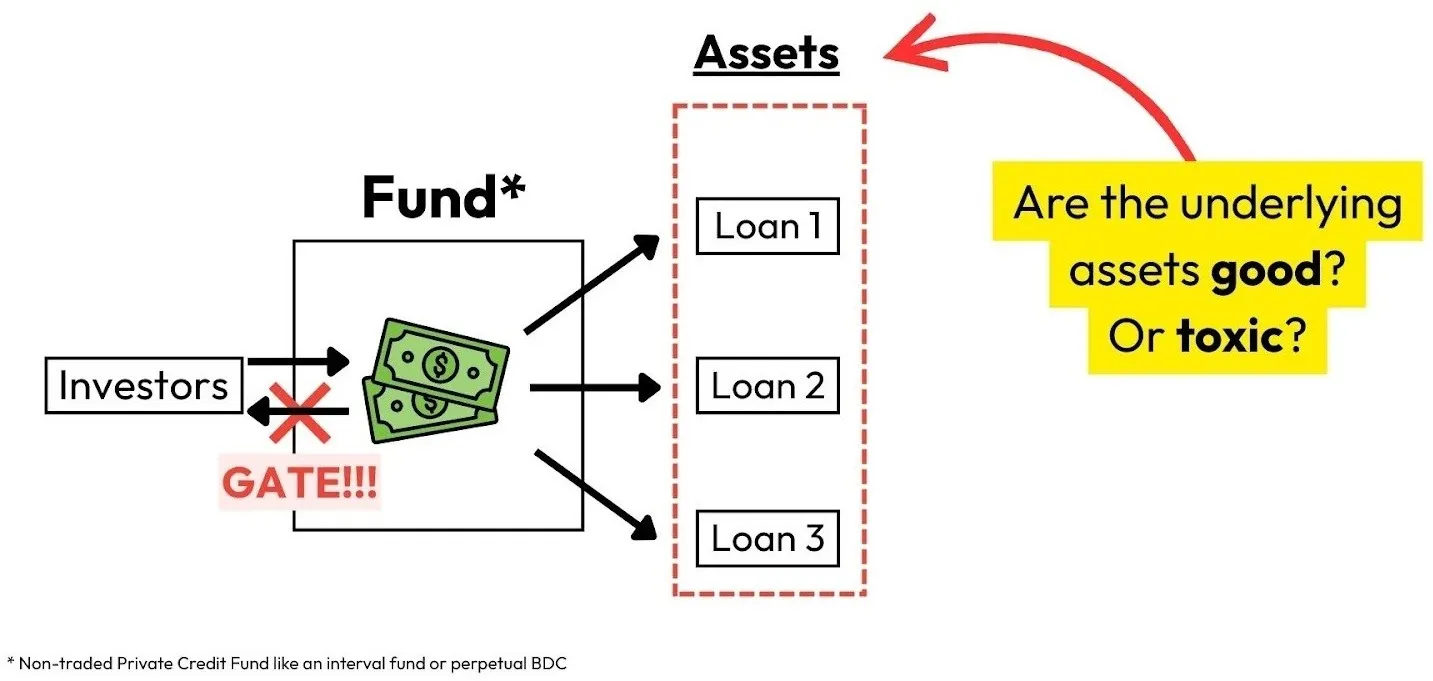
To give retail investors access to private credit and long-dated non publicly traded assets generally, Wall Street created a few different “products” to address liquidity concerns. In plain English, it means they tried to create structures that would allow retail investors to cash out when they wanted to, despite the underlying assets being illiquid.
The first structure is a Business Development Company (“BDC”), which is a legal and regulatory classification. It’s a type of closed-end fund that must invest at least 70% of assets in private U.S. companies, typically via debt. BDCs must be registered with the SEC and come in two sub-flavors for retail that we’ll focus on:
- Publicly traded BDCs: listed on an exchange (NYSE, etc.), daily liquidity, the market sets the price. Think of Blue Owl’s OBDC. The stock can trade at a premium or discount to Net Asset Value (NAV) just like any public equity. Right now, OBDC is trading at a ~20% – 25% discount to NAV.
- Non-traded perpetual BDCs: SEC-registered, but not listed on an exchange. Shares are priced at NAV, but not by the market. Instead, they are marked by the fund itself. They offer quarterly redemptions, typically capped at 5% of shares, and at the board’s discretion. They’re designed to run indefinitely, hence the name “perpetual.” This is Blackstone’s “BCRED”, Blue Owl’s “OBDC II”, and BlackRock’s “HLEND”. But the key difference is: they can GATE and shut down redemptions if they need to.
Now, not all “retail products” for private markets are BDCs. There are other structures. For example, an interval fund is a different legal structure that looks very similar to the non-traded perpetual BDC (#2 above).
Critical distinction: an interval fund is required by regulation to offer periodic repurchases (typically 5-25% of shares quarterly), whereas a non-traded BDC’s repurchase program is discretionary, and the board can reduce or eliminate it.
With that said, these funds can still enforce caps….
One of the gated funds — Cliffwater’s $33 billion Corporate Lending Fund, run in partnership with Morgan Stanley — is an interval fund, not a BDC. Interval funds also tend to have lower leverage (they don’t get the same 2:1 leverage allowance BDCs do) and lower fees. News broke a few days ago that Cliffwater wasn’t gating entirely, but rather that they were “limiting redemptions” by enforcing “caps”.
To summarize, the funds in the news making headlines right now are these:
- Non-traded perpetual BDCs (BCRED, OBDC II, HLEND) — discretionary quarterly redemptions, gated when boards choose.
- Interval fund (Cliffwater CCLF) — mandatory quarterly repurchase required by regulation, but can be capped at 5-7%.
- Publicly traded BDC (Blue Owl’s OBDC) — daily liquidity, trades at a market price, currently at a roughly 20% – 25% discount to NAV.
Gating: A Timing Mismatch
So let’s now talk about WHY we’re seeing gating…and why it’s a feature, not a bug, when it comes to these types of investment vehicles.
These funds hold long-dated, illiquid assets — loans to private companies with maturities of five, six, seven years or more. Those loans cannot be sold quickly without taking a significant haircut.
But the investors in these funds are seeing negative headlines about Private Credit – stories about fraud, lax lending, and concerns about a SAASpocalypse. So they’re feeling panicked, and they want out quickly.
This is a fundamental timing mismatch.
You have long-duration assets on one side and short-duration investor expectations on the other.
But here’s the thing: gating can help prevent a crisis.
Without gating, it’s a classic run on the bank. Too many investors demand their money back at once when the fund doesn’t have enough liquid cash to meet the redemptions. So it’s forced to sell its loan positions — remember, those long-dated, illiquid ones — at fire-sale prices, whether those assets are good or bad. Those fire-sale prices cascade. They mark down the value of similar loans across the entire market, which triggers more panic, more redemptions, more forced selling…it’s a death spiral.
Gating prevents the fund having to liquidate performing, long-dated assets just because people are scared. Assuming borrowers are still making interest payments and the health of the companies that took out loans is good, as long as everyone can just wait, the value is there.
Jen talks about it in terms of the Treasury futures basis trade — one of the most legendary trades in fixed income markets. It’s essentially an arbitrage: two things that are effectively the same risk but trade at different prices, and if you hold the position for three months, you can make a killing. But it’s implicitly a short-volatility position. You just need enough time (and margin) to wait for things to converge. If you’re a hedge fund with daily liquidity and investors start pulling out during a mark-to-market drawdown, you can be forced to unwind a position that would have been money-good if you could have just waited it out.
Private credit funds without gating would face the exact same problem. You’d be liquidating fundamentally sound loans at distressed prices simply because of a timing mismatch, NOT because the underlying assets are bad.
Therefore, the underlying question is…
What’s Actually Inside These Funds?
OK, so if gating is the structural issue, the next obvious question is: what about the actual loans? Are the underlying assets okay?
Let’s look at what we can see inside the three non-traded perpetual BDCs at the center of the storm. And the first thing worth noting is how little we can see — which is itself part of the story. These are private companies, and these retail private-credit funds disclose far less portfolio-level data than public credit markets.
The Three Non-Traded Perpetual BDCs
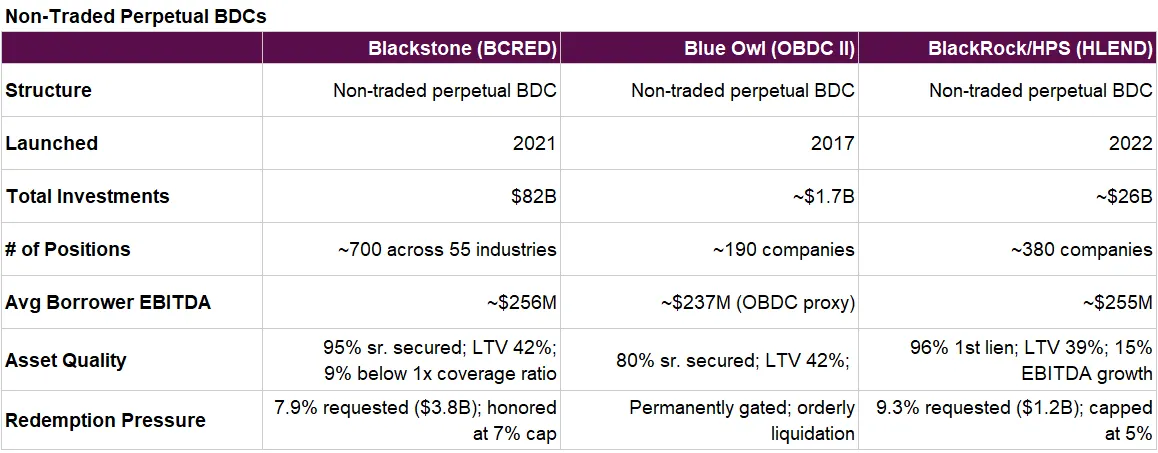
Blackstone (BCRED) is the largest non-traded private credit fund at roughly $82 billion in total investments and $47.6 billion in NAV as of December 2025. The portfolio spans about 700 positions, with average borrower EBITDA of ~$256 million. We could NOT find information about leverage at the time of underwriting or now although they DO disclose average loan-to-value around 42% at the time of underwriting, which means if the companies were worth 10x, the leverage was about 4.2x. They also have 95% is senior secured debt.
Industry concentration skews toward software, professional services (which makes up 37%), and healthcare. Blackstone reports that portfolio company interest coverage improved from about 1.6x in early 2024 to roughly 2.1x by year-end 2025, as rates stabilized and earnings grew about 10%.
That said, approximately 9% of their debt investments (including ARR loans, a type of debt financing tailored to “high growing SAAS businesses rather than traditional EBITDA) which still have less than 1.0x interest coverage. This means those borrowers’ operating cash flow barely covers their interest payments.
BCRED faced record redemption requests of 7.9% of shares (approximately $3.8 billion) in its most recent quarter. The board upsized the repurchase offer to 7%, the maximum allowed, and Blackstone employees stepped in with direct investments to cover the remainder.
Blue Owl (OBDC II) is the fund that lit the match. Important distinction: this is Blue Owl Capital Corporation II, the non-traded perpetual BDC — not the publicly traded OBDC (which currently trades at a 20-24% discount to NAV). At ~$1.7 billion though, it’s tiny relative to BCRED and HLEND.
In February 2026, Blue Owl permanently halted redemptions at OBDC II after investor withdrawal requests surged beyond the 5% quarterly cap. This came after a failed attempt in November 2025 to merge OBDC II into the larger, publicly traded OBDC — which would have given investors real liquidity but at a roughly 20% haircut to stated NAV. When that fell apart, Blue Owl instead sold $600 million of OBDC II’s loans — roughly 34% of the fund’s portfolio — to four North American pension and insurance investors at 99.7% of par value, and will return that capital to investors as a special distribution of up to $2.35 per share (about 30% of NAV).
Prior to the sale, OBDC II had fund-level leverage of 0.83x, meaning for every $1 raised they lent $1.83; after the asset sale and debt repayment, that drops to roughly 0.53x.
Public disclosures on OBDC II itself are limited, but the public sister fund OBDC — which uses a very similar strategy and shares many investments — reports weighted average borrower EBITDA of roughly $237 million, average revenue over $1 billion, interest coverage of 1.9x, net LTV of 42%, and 3.2% of the loan book (at cost) is non-performing.
Blue Owl has said the two funds have substantial portfolio overlap, which is why analysts use OBDC as a proxy for OBDC II’s credit quality.
BlackRock/HPS (HLEND) has roughly $26 billion in total investments across about 380 portfolio companies, with average borrower EBITDA around $255 million. The portfolio is 96% first-lien senior secured with a weighted average LTV of 39%, and borrower EBITDA grew 15% over the past year.
In early March 2026, HLEND gated: investors requested to redeem 9.3% of shares (roughly $1.2 billion), and the board capped repurchases at 5% — returning approximately $620 million and leaving the rest unfulfilled. ___________________________________________________________________________
Now it’s important to note…these are incredibly prestigious fund managers who likely have access to some of the best deals. This is not necessarily representative of “private credit” broadly. So while these funds may look okay, other smaller managers may have very different underlying assets. The quality of managers and their lending standards is going to be paramount.
What is even MORE interesting however, is how will the loans fare in a workout if the company goes through a bankruptcy and restructuring. We’ll be re-releasing our breakdown of Caesars Palace Coup which was one of the first places we saw “CREDITOR ON CREDITOR VIOLENCE,” which have started to become more and more common place.
So not only does manager selection matter in terms of lending standards, but will also be important for hiring the expensive lawyers who can duke it out in bankruptcy court.
Here’s an additional point: none of these funds prominently disclose a simple portfolio-wide borrower leverage number — debt-to-EBITDA — in aggregate, which is what I wanted. They give you LTV, interest coverage ratios, average borrower EBITDA, and fund-level leverage. What the industry data tells us: across middle-market private credit, typical leverage runs roughly 3.5-4x EBITDA for first-lien loans and 5-5.5x for unitranche structures at underwriting.
Over time, you’d expect companies to pay down debt. HOWEVER, these are perpetual finds so they’re constantly investing in new deals.
And then there’s the growing use of payment-in-kind (“PIK”) interest, which is basically borrowers saying “I can’t pay you in cash right now, just add it to my tab.” By mid-2024, per the FT, roughly 10% of BDC interest income was coming from PIK rather than cash.
Between debt balances creeping up via PIK and possible EBITDA deterioration if this whole SaaSpocalypse plays out, leverage could start ticking up instead of down.
The headline default rate in private credit remains low — typically reported around 1-2%. But once you factor in selective defaults and liability management exercises — the increasingly creative ways borrowers and their PE sponsors restructure debt without triggering a formal default — the true default rate approaches 5%.
Why this is Worse than 2007 Vintage CLOs
Credit quality has deteriorated.
What your average person doesn’t realize is that in 2008, CLOs came out ahead. The “toxic assets” at the heart of the crisis were loans made to people to buy houses (a.k.a., mortgages). Lax lending standards for “subprime borrowers”, and subsequently the CDOs backed by those subprime loans, are what caused the system to unravel. CLOs — which were backed by loans made to companies, not individuals — got caught up in the negative press, but performed quite well because the underlying loans were good. Not to mention the Fed cut rates to zero which was huge. Corporate defaults only reached about 2% in those CLOs structured in the 2006 / 2007 credit boom heyday.
What’s happened since is fundamentally different. Standards changed for mortgage lenders, but corporate lending is a different story. As money flooded into private credit, there has been too much capital chasing too few deals, meaning borrowers had all the leverage (pun intended) in negotiations. Lenders, desperate to deploy dry powder, started competing by offering friendlier terms. “Friendlier terms” meant stripping out covenants and doing whatever they could to get into deals.
As competition intensified, many private credit portfolios today contain loans with fewer protective guardrails than there were PRE-GFC!!! And as we go into this next phase — as one credit investor told us — “Private Equity firms see loose covenants as an asset” that they can leverage when things go wrong…
It’s also worth noting that Liability Management Exercises aside, Moody’s also recently published a paper showing first lien recoveries have fallen from ~80 cents to ~60 cents on the dollar.
With that said, I’d also love to know what default and recovery assumptions these funds are modeling for SaaS businesses specifically.
The Other Risks Worth Watching
There are a few more things we’re watching:
The SaaS exposure. A lot of private credit lending went to fund leveraged acquisitions of software companies. The thesis was that SaaS businesses have predictable, recurring cash flows, which makes them attractive to lenders. But if AI actually does start displacing some of these businesses, the collateral value is thin. A pipe-fittings company has hard assets to recover. A SaaS company whose product is a wrapper on someone else’s AI tool? Yank on that thread and the thing unravels. That said — and we talk about this all the time — we’re not getting replaced by AI in the next two to four years (we hope, haha). Timelines are important, and these are loans with defined maturities. As long as companies can make their interest payments and continue to operate, the lenders are ok. Although that can turn on a dime.
Fraud. We’ve already seen cases — Tricolor, First Brands — where things were simply not as represented. First Brands and MFS committed fraud by “double pledging collateral” — akin to a homeowner using the same house to get two different mortgages from two different banks and borrow twice the money. That’s what these companies were doing. In a portfolio of a hundred loans, even a few instances of fraud spook investors. Though it’s worth noting: a few bad loans in a diversified portfolio is not the same as systemic failure, BUT because of the frothiness at the time of origination, there may be more instances of fraud than there otherwise would be.
The gating psychology. The more funds that gate, the more investors in other funds start putting in redemption requests preemptively. It can become self-fulfilling even if the underlying assets are fine. Fear feeds on itself.
The Bottom Line
Here’s where we come out on this: private credit is not the CDOs of 2008. It’s not going to be the domino that takes down the financial system because the systemic interconnectedness isn’t there the same way.
But that doesn’t mean the broader picture looks great. Rising oil prices, a shaky real estate market, potential increases unemployment from AI, rising costs from tariff fallout — there are plenty of things that could cause a downturn.
Private credit is one crack among many. History doesn’t repeat, it rhymes.
The gating mechanism itself is doing what it’s supposed to do: preventing a timing mismatch from turning into a death spiral.
If you’re invested in private credit, the question you should be focused on is who is the manager, what were the underwriting standards, and what is the quality of the underlying loan portfolio? Manager selection matters enormously. A fund run by experienced credit investors who’ve been through cycles before is a very different animal from a shop that started five years ago and has never seen what happens when things go bad.
Quality matters. It always does. And when sentiment turns, it matters more than ever.