

By Jen Saarbach & Kristen Kelly, Co-Founders of The Wall Street Skinny
FX interventions explained…and graded.
When it comes to Scott Bessent and the U.S. Treasury, the theme of the past 2 months has been “intervention”. Those with long memories point to Bessent’s earlier critiques of Janet Yellen, arguing that he’s employing the very same tactics that he so vehemently opposed under her oversight. But those with LONGER memories of his time as a risk taker at one of the world’s most (in)famous hedge funds aren’t one bit surprised.
Instead, what’s truly counterintuitive is: he’s doing the exact opposite of what made him a fortune, particularly in the currency markets. Let me explain.
Scott Bessent cut his teeth trading at the legendary macro hedge fund Soros, run by — you guessed it — George Soros, along with his partner Stan Druckenmiller. Macro hedge funds trade big global themes: monetary and fiscal policy, geopolitical trends, debt supply & demand, economic cycles, etc. In addition to the strategy most people think of as trading — namely, being long or short equities — they often express a view by buying or selling sovereign debt and currencies, a.k.a. trading rates & FX.
Interest rates and currencies are inextricably intertwined. All else being equal, people want to borrow money at lower rates and lend money at higher rates. If I can identify a country that consistently has low interest rates — like say, Japan — I’ll try to do as much of my borrowing there as I can. I’ll then invest the money I borrow in a country with higher interest rates — like, say, the U.S. In order to do that, I first need to sell the JPY I borrowed and buy USD.
This is called a “carry” trade — where you make money by lending money at a higher rate than that at which you borrow. It’s a play on the old trading adage “buy low, sell high” — where, to be precise, you borrow low, lend high.
The best part about a carry trade? You don’t just make money if things move your way. You make money even if NOTHING CHANGES.
Here’s an example…
Starting assumptions:
USDJPY = 100
JPY 1 year interest rate: 1.00%
USD 1 year interest rate: 5.00%
- Borrow ¥100mm for 1 year @ 1.00%
- USDJPY = 100, so ¥100mm / 100 = $1mm
- Invest $1mm for 1 year @ 5.00%
1 year later…
Scenario 1: USDJPY unchanged @ 100
- You’ve earned 5.00% interest. $1.05mm x 100 = ¥105mm
- You’ve paid 1.00% funding. ¥105mm – ¥101mm = ¥4mm → 4.00% profit
Scenario 2: Yen weakens, USDJPY @ 120
- You’ve earned 5.00% interest. $1.05mm x 120 = ¥126mm
- You’ve paid 1.00% funding. ¥126mm – ¥101mm = ¥25mm → 25.00% profit
Scenario 3: Yen strengthens, USDJPY @ 80
- You’ve earned 5.00% interest. $1.05mm x 80 = ¥84mm
- You’ve paid 1.00% funding. ¥84mm – ¥101mm = –¥17mm → 17.00% loss
In scenarios 1 and 2, look how much money I earned by LITERALLY DOING NOTHING. And in scenario 1, I didn’t even have to be right! Nothing changed, and I still got paid. You can see why these things are so attractive.
However, you’ll also notice that the majority of my PNL is driven by the currency move, not the rate differential. Said differently, as you can see in scenario 3, the handful of basis points you earn in carry can get wiped out pretty quickly by a big move in the currency pair. It’s like picking up pennies in front of a steamroller.
Moving on. The philosophy behind trades like these is all based on fundamental drivers like fiscal and monetary policy.
But here’s the thing. Governments and central banks will sometimes try to hold their currencies at levels that the fundamentals don’t actually support. They will often intervene or enact emergency policies to accomplish their goals.
And if you’re a gutsy trader with a bunch of capital and some really high risk tolerance, you might just be able to break their grip.
Scott Bessent was a 30 year old analyst when he helped Soros and Druckenmiller spot a situation just like this with the Bank of England and the British Pound. We did a full video on this a few years back, and Soros “breaking the bank of England” is still held up as a cautionary tale about maintaining central bank credibility. Long story short, these guys bet against the British Pound, and were able to do so in such size and with such favorable macro tailwinds that, despite emergency rate hikes, the Pound crashed 15%, netting Soros at least $1bn.
Then, Bessent was in his early 30s when he saw the yen drop from JPY80 to 147 in just three years’ time, taking the currencies of Korea, Thailand, and Indonesia down with it. Japanese banks borrowed cheaply with 0.5% interest rates and lent dollars or local currencies all around Asia at double digit interest rates in the original version of the infamous “yen carry trade”. All fun and games until the Asian financial crisis in 1997-1998, which saw U.S. Treasury Secretary Robert Rubin buying about $2bn yen in coordination with Japan. That took USDJPY from 144 to 136 in a single session…but their intervention didn’t survive the Russian default in August of 1998, which took the yen back to 147 and helped bring about the collapse of LTCM. As LTCM went down and took leverage out of the system, the carry trade unwound violently, with USD/JPY dropping from 135 to 112 in 3 days. Tiger Management, another famous macro hedge fund, reportedly lost $2bn in a single day. And Soros, who was already hurt by the Russian default, got caught in the same squeeze.
The lesson learned there? FX carry trades don’t typically collapse because the high yielding side of the trade suddenly vaporizes. It dies because the funding currency — the side that everyone is short — rallies, and rallies hard, just when everyone’s trying to cover all at once. Carry trades are, as John Normand put it so well in his explainer on our show, “up by the stairs, down by the elevator shaft.”
Bessent learned this lesson firsthand. But instead of wiping his hands clean of carry trades, he adapted.
By the time he was Soros’ CIO in the 2010s, Scott Bessent was credited with ~$10bn in profits, including a $1bn short against the Yen in 2013. That was the famous “Abenomics” trade: Prime Minister Shinzo Abe came into office promising a weaker yen, the BOJ delivered, and Soros’ short profited massively.
Turns out the real lesson wasn’t so much “don’t play the carry trade”, but more like “don’t fight market fundamentals”. If those fundamentals happen to be aligned with government action, keep calm and carry on (see what I did there?).
Which brings us to 2024 — the last time Bessent gave us insight into his trader’s viewpoint before becoming a member of the cabinet. Bessent went on Bloomberg that June and chastised Yellen’s decision not to term out the Treasury’s debt during the COVID era of zero interest rates.
“When rates are very low, you should extend duration,” was his argument, and an unassailable one in my view. What he was suggesting was that it was a judgment error not to load up issuance in the 10-30 year part of the yield curve when rates were at historic lows, and that Yellen had erred by “financing at the front end”. By sticking to the schedule and borrowing massive amounts of money due back in a relatively short time, rather than strategically terming out the government’s borrowing, the government wasn’t thinking like a trader. He suggested the government should float a one-off ultra-long bond to test demand (a la the Universities and tech companies we’ve seen issuing 100-year bonds).
Ultimately Bessent accused her of “making a bet on the carry trade, which is not good risk management”. What he means is, funding long-term deficits with short-term debt is a carry trade…and the government is short the funding leg.
From a pure trading standpoint, I find it tough to argue with anything here, and would challenge others to make a reasonable argument for why this critique is anything but sound. There’s a reason most people prefer 30 year mortgages over 15. There’s a reason tech companies are rushing to issue debt with 30, 40, and 100 year terms. Securing a predictable, fixed stream of known costs to fund yourself for as long as possible MAKES SENSE when rates are low.
Now Scott Bessent is no longer a trader at a Hedge Fund — he’s the U.S. Treasury Secretary himself.
How has he applied the lessons learned about carry trades to policy? And what does it mean for the markets?
On Thursday, July 30th, USDJPY traded up to 163.76, putting the Yen at its weakest levels in forty years or so. Japan spent an estimated JPY8.45 trillion (~$52.8bn) that day alone in what was likely the largest single-day intervention the MOF has ever done. The next day, a Reuters photographer at Camp David snapped the photo below:
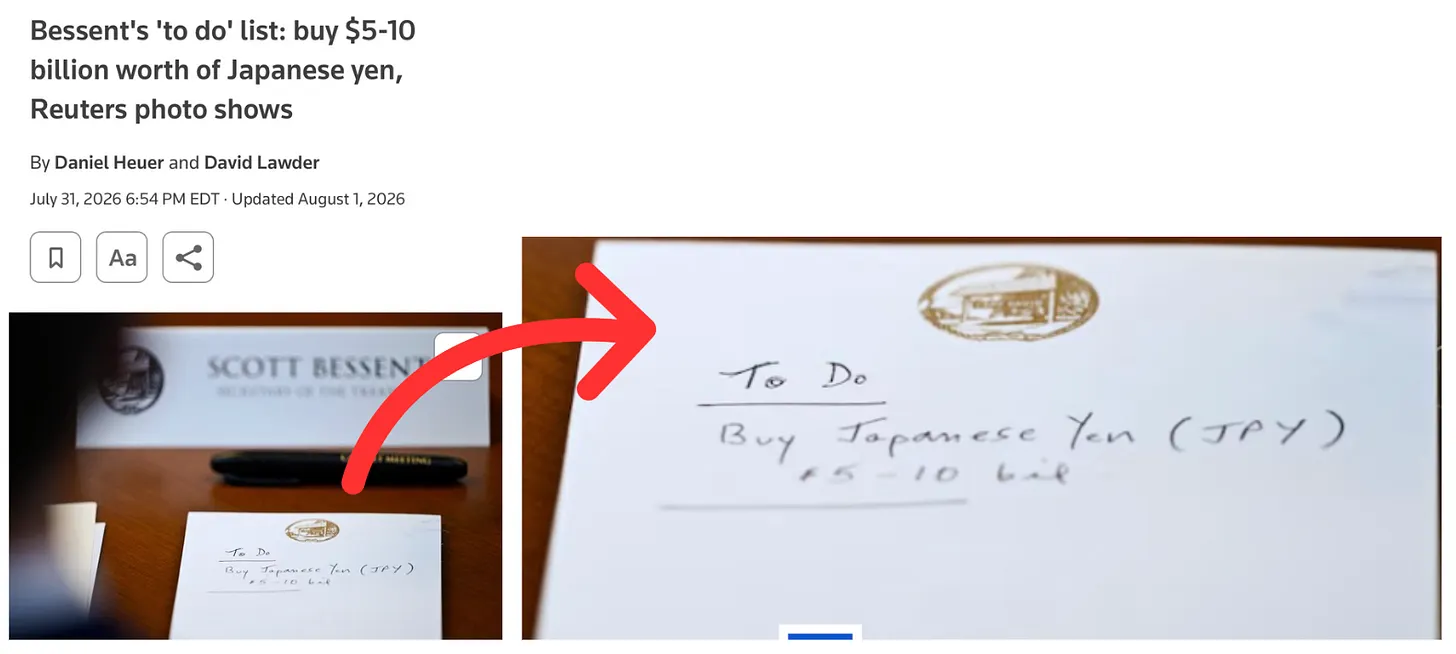
Later that day, it seems the U.S. did…exactly that. The NY Fed sold Euros and bought Yen on the Treasury’s behalf through Goldman Sachs and Morgan Stanley. It was, by all accounts, the first time the Treasury and MOF jointly bought Yen together since 1998 — when Scott Bessent was sitting in a trader’s seat. USDJPY went from 163.76 down to around 157 by the end of the week.
Why intervene at all? Many have pointed to fears that Japan (the world’s largest foreign holder of U.S. Treasurys) would start liquidating its Treasury holdings to raise cash in order to defend its own currency. Now, Japan’s finance minister said most of their dollar selling would be financed through the Fed’s FIMA repo facility (where they can pledge Treasuries as collateral to raise cash), a facility that Bessent has loudly called for expanding.
A fine theory, which rhymes with Scott Bessent’s own interventions in the bond market, but might not capture the full picture. Bessent has also spent the last two months grabbing every microphone he could get his hands on to make this point: he knows something we don’t.
In mid-August, Bessent told Bloomberg TV that the BOJ was “behind the curve. So they’re going to be hiking”. At the G20, after meeting with Governor Ueda, Bessent told Reuters he expected Ueda to “do the right thing” when it comes to monetary policy action to combat weakness in the yen.
Then he put things more bluntly when he spoke at the Charlotte Economics Club: “I’m the house now. I have information the market doesn’t have, and it’s my belief that the BOJ will do things that will lead to a stronger yen.” When explicitly asked if that meant rate hikes, he answered “I think the market’s pricing that in now.” And in response to the inevitable raised eyebrows, he explicitly said: “you can bet against me if you want…”
Bessent was calling out his buy-side counterparts, the “Bessent of yore” if you will. The listener wearing his/her trader hat, ready, willing, and able to deploy serious capital to test an unserious government should the opportunity arise. He was taunting his younger self, daring them to call his bluff. It begs the question, does a man who feels vulnerable take that kind of risk? Or is this the same bravado and posturing we’ve seen time and time again from the head of the Executive branch?
If you’re a trader, the PNL matters more than the posturing, and when it comes to USDJPY, Bessent had both in his favor. Bessent intervened north of 163, and it was trading around 153 when I started writing this article. In July, the odds of a BOJ rate hike were 23%. By last week, the odds of a BOJ hike had risen to 83%, and the yen OIS market was implying about 75bps of cumulative tightening by April of 2027. It looked like Bessent had bought the lows.
Well, the BOJ finally showed their cards. On Friday, the BOJ hiked to 1.25%. Not only is this the highest Japanese policy rate since 1995, but they’ve doubled the pace of their hiking, moving only three months after their last hike instead of six.
So why is USDJPY back up to 157? Shouldn’t Bessent’s trade be working better than ever?
A few reasons why it’s not.
First, as every trader knows, when a trade that’s fully priced delivers on its premise, you unwind. Confirmation of your thesis typically means it’s time to take profit, rather than pile on.
Secondly, the BOJ vote was a 7-2 split. The two dissenters were “reflationists” (i.e., Abenomics protégés who view hikes as policy missteps standing in the way of a strong economy), and Ueda’s communique gave mixed signals on future hikes.
But third — and arguably most importantly — I conveniently forgot to mention the fact that, 48 hours prior, the Fed hiked rates 25bps for the first time since July 2023 in a unanimous vote, with hawkish posturing in both the statement and press conference. And p.s., Warsh clued the market into this bias way back at Jackson Hole on August 28th.
Both central banks hiked in lockstep. So despite the BOJ’s hike, the US – Japan monetary policy rate differential remains effectively unchanged, and the carry trade intact.
If we chart the past quarter’s worth of FX and monetary policy rates, you can see the story written out plain as day:
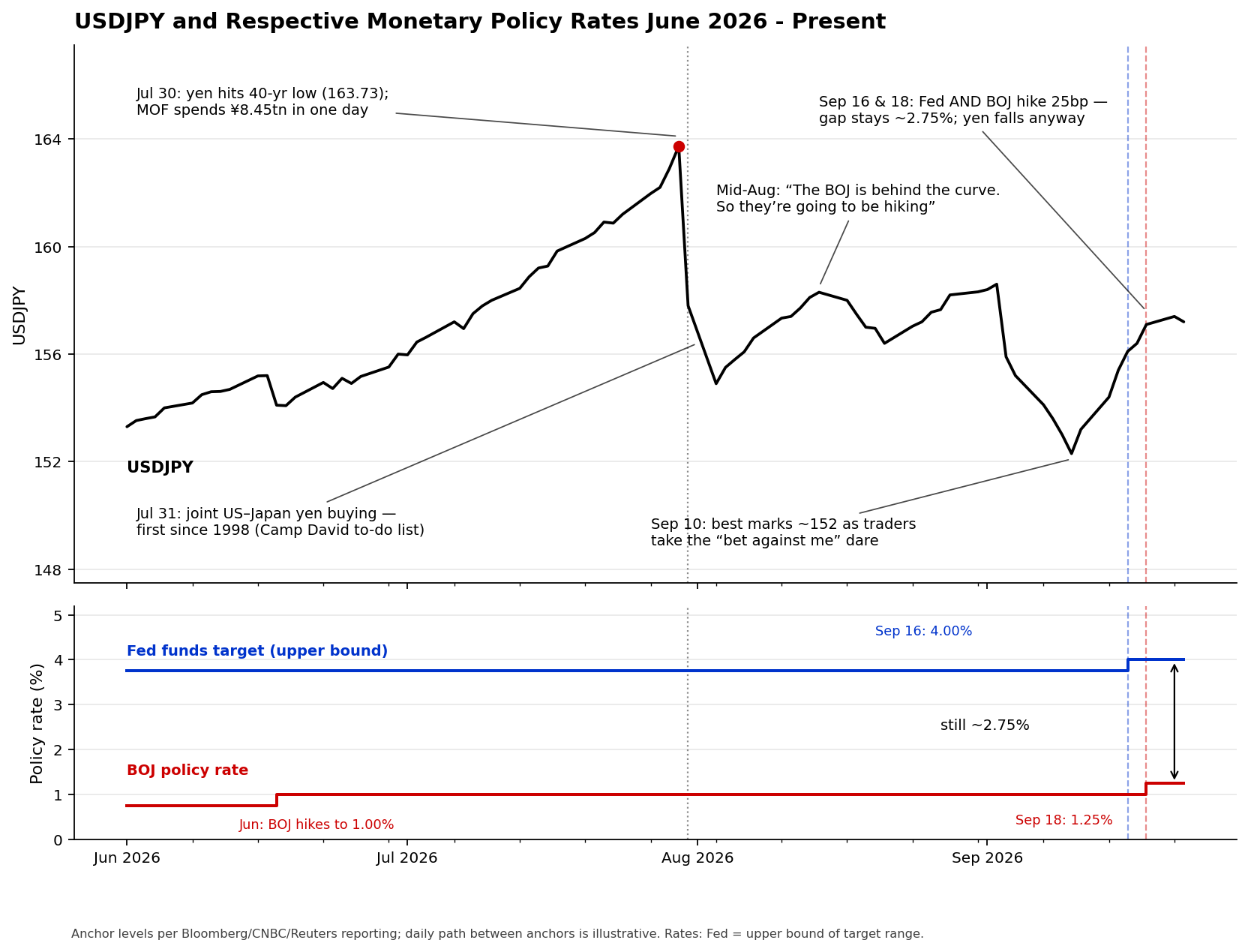
While Bessent’s intervention is still comfortably in the money, the market has taken back at least four big figures since he dared the “Bloomberg terminal bros” to bet against him. Some desks are already saying a run towards 160 could force another intervention. The next major economic event will come the last week in October, when the BOJ meets with a fresh Outlook Report.
Here’s what I just don’t get.
Bessent made no bones about the fact that he had inside info on the BOJ. But — as he knows better than anyone — a carry trade isn’t an outright bet on one central bank or another. It’s a bet on their rate DIFFERENTIAL. Despite all the taunting and interventions, the only real fundamental that matters when it comes to this FX pair is the interest rate gap. Who cares if the BOJ is about to hike rates if the Fed is doing the same thing simultaneously?
So, is Bessent doing the exact opposite of what made him a fortune?
On the surface, the answer seems to be “yes”. But that answer drives me nuts, because come on, if he knew the BOJ would be hiking, there’s no way he didn’t know (or at least, didn’t have an extremely strong suspicion) that his old buddy Kevin Warsh would be doing the same. The market was pricing in a 68% chance of a rate hike in the week prior to the Fed meeting, rising to 92% after the September 11th CPI print. A trader with his experience daring the market to bet against him while knowing the outcome would be banal just doesn’t make sense.
The way I see it, there are three possible explanations:
1) Like I said in my article about his bond market interventions, traders are gonna trade. Maybe he just can’t help himself from talking his book, and after 30 years trading around the whims of governments, it might feel really good to throw your weight around as the government itself.
2) He overplayed his hand, and the BOJ underdelivered. While the gist of his inside information was good, the 7-2 vote combined with Ueda’s softer language about the path of future hikes gave the market pause. Just knowing the binary outcome of one rate decision doesn’t necessarily help you for the trading day after.
3) We’re still treating Bessent like a trader, not like a policymaker. And who could blame us, given the language he’s used? But this whole analysis assumes that Bessent “wins” if USDJPY goes to 140.
Let’s reexamine the premise of why he intervened in the first place. Bessent didn’t need the yen to rally per se. What he needed was market stability. He needed the one-way, frantic, disorderly rush towards 165-170 to stop. He saw how that movie ended in 1997. And no matter how much Bessent expands FIMA, no repo facility is infinite in its capacity. If Japan needs to make more extreme interventions, it’s highly possible Treasuries get torched as collateral damage.
If we start scoring Bessent’s intervention back on that original premise, 157 seems just fine. Japan is defending its currency with good old fashioned monetary policy, not by liquidating Treasuries. And the carry trade might be bleeding out, but it’s not violently unwinding.
Assuming this third explanation is the right one, Bessent is doing the opposite of what made him a fortune, but without contradicting the lessons he learned. Perhaps counterintuitively, he’s taunting the markets into a calmer, gentler landing than the markets might otherwise achieve on their own.
Whether it’s genius or hubris remains to be seen.