

By Jen Saarbach & Kristen Kelly, Co-Founders of The Wall Street Skinny
What that means for the AI trade AND reveals about the SpaceX-Tesla merger
We always hear how the biggest constraint on the AI trade is compute, or the lack thereof. There aren’t enough chips, not enough data centers, nowhere close to enough energy…
But what if it’s something far simpler? What if instead the biggest constraint is good old fashioned capital?
Case in point. When we gave you our rundown of the Anthropic IPO, we highlighted the risks of nearly $900bn worth of off-balance sheet liabilities — remember, money these companies owe to other people, but which technically doesn’t show up as debt when you’re doing a traditional valuation analysis.
But they’re not the only ones with off-balance sheet risk. Much of the AI buildout hasn’t been done through the conventional bond markets, but rather through special purpose vehicles. We talked about this extensively as it relates to Coreweave, one of the neocloud names that has been the subject of tremendous investor apprehension.
It turns out the same story also applies to the hyperscalers. We want to focus on one hyperscaler in particular: SpaceX, and its wild attempt to raise debt over the past month.
I want to explain how SpaceX’s nearly-failed chip backed financing deal is actually the key to understanding its potential merger with Tesla.
Backing up. This past February, as you’ll recall, SpaceX bought xAI, which had previously acquired X. Part of the big rationale behind SpaceX’s acquisition of xAI, as I’m sure you’ll remember, was data centers in space. Before that, xAI had bought X (the artist formerly known as Twitter), the latter in trouble due to sagging ad revenues.
The prevailing narrative is that whenever one of Elon Musk’s companies is struggling, he swoops in with another one of his companies to buy it.
Four months after buying xAI, SpaceX IPOed to raise $86bn. They then tapped the bond market within two weeks for ANOTHER $25bn worth of bonds, ranging in maturities from 5 to 30 years. Not only did the debt announcement cause the stock to drop 16% in a single session — they lost $400bn in one day and over $600bn over a three-day decline — but even though those particular bonds were rated BBB (still investment grade), they immediately started trading like a dog with fleas.
To be clear, these bonds weren’t used for new CapEx — they were refinancing a $20bn bridge loan, which had ITSELF been used to refinance $17.5bn of leftover X and xAI debt. Remember, Elon’s initial purchase of X was essentially a leveraged buyout. Musk put in about $20 billion of equity (funded largely by selling Tesla shares) and borrowed $13 billion of debt (syndicated led by Morgan Stanley and BofA), which worked out to a leverage of ~9x on its “adjusted EBITDA” of $1.4bn, putting it squarely in leveraged buyout territory.
THIS WHOLE EXERCISE was taking SpaceX’s investment grade rating and using it to finally launder all the old Twitter and xAI junk into more highly rated bonds. When it comes to investment grade (“IG”) corporate debt, investor appetite these past few years has been boundless. Except, most IG debt comes from profitable companies. After the initial frenzy, everyone woke up, realized SpaceX had yet to turn a profit, and spreads blew out.
Those bonds were issued at something like 140 bps spread to Treasuries — already ~40bps wide of the BBB index. SpaceX 5Y CDS is now trading right around 271 bps, which implies a ~20% cumulative chance of default over the next 5 years. Not only that, but the Treasury market itself has sold off.
Reminder: we can ballpark the all-in rate on a corporate bond by adding the yield on the corresponding Treasury + a credit spread. I’m using round numbers here for illustrative purposes only; in reality, we’d need to apply cash bond spreads specific to each tenor, not just use 5Y CDS as a stand-in.
So let’s take 10 year Treasuries for example. Using nice round numbers, 10s were trading around 4.50% when they issued their debt in June; they’re now at 4.90%, and recently got as high as 5.30%. SpaceX’s credit spreads are more than 130 bps wider. So back of the envelope math, using the 10y point as our proxy, they issued at call it 5.90% and would now not be likely to be able to issue that EXACT SAME BOND for less than 7.60%.
In reality, if they tried to come to the bond market, investors would likely demand even MORE of a concession. As we saw last week, the market is so jittery now there’s a world in which the whole thing runs away from them.
TLDR: it’s a lot more freaking expensive for SpaceX to borrow money than it used to be.
But we all know that every one of these AI guys needs to fund their CapEx somehow. Elon wants to build Starbase, Colossus, and Colossus 2, these giant data centers. The most expensive part of data centers is chips. Elon’s gonna need a lot of them.
Now back in 2025, xAI had structured these chip leases with Private Equity and Private Credit firms, where instead of raising a whole bunch of cash to buy them outright, the PE firm sets up a vehicle to buy the chips and the company just rents them from that vehicle. It’s something that’s really common with airplanes, where the underlying collateral has enough value, fungibility, and useful life to trade hands for decades. The reason they do this as leases is because operating leases get treated more gently than real debt by rating agencies and bond investors and show up as a straight line expense.
They set up a program to do up to $20bn worth of financing like this. The tranche I could get the most detail on — courtesy of Michael Burry’s substack — was one for $5.4bn with Valor Equity Partners, where they set up the investment vehicle, manage it, and probably put some equity in. NVIDIA reportedly then contributed the majority of the $1.9bn equity check, and then Apollo’s funds lent that vehicle $3.5bn. This pile of cash, which was called Valor Compute Infrastructure (“VCI”), bought (per Burry) about 100,000 NVIDIA chips. There’s a separate conversation to be had about the idea that NVIDIA writes that equity check and then the cash is used to buy NVIDIA chips, the sale of which is booked as revenue, but that’s for another day, because it turns out there was a much bigger problem with the structure.
If they aren’t buying the chips from NVIDIA, but instead they are taking chips already purchased by, or committed to be purchased by xAI, then it’s not a lease — it’s a sale-leaseback. An xAI subsidiary bought the chips first, then sold them to the investment vehicle, and rented them back.
This is still perfectly legal AND it doesn’t have to be counted as traditionally funded debt as long as it meets certain criteria: specifically that you fully give up control of the asset and don’t have an ongoing buyback option.
They failed that test though. In their auditor’s view, xAI’s subsidiary still had control of those assets, meaning the leasebacks would have been classified as finance leases, which get treated a lot more like “real debt” than operating leases.
So when SpaceX bought xAI, something like $13bn worth of these failed sale-leaseback arrangements had to be classified as debt on their balance sheet.
Now, with this as background, at the beginning of October, SpaceX reportedly was in talks with Apollo and PIMCO to do a NEW $40bn deal to raise money. It constituted the largest GPU financing to-date.
SPCX stock fell on the news because the story of October was “nobody wants your AI bonds (at least, not where you could issue them before)”, and things only get worse. We got the blowup in the neoclouds — who all use SPV structures for their financing in addition to their publicly traded bonds, which have widened out massively.
Almost three weeks ago, the same week that CoreWeave’s bonds were newly yielding 15%, Bloomberg ran an exclusive saying the deal had hit “obstacles” — aka, investors are running in the other direction and no one wants these things.
This pissed Elon off. So that Sunday, he writes the following tweet:
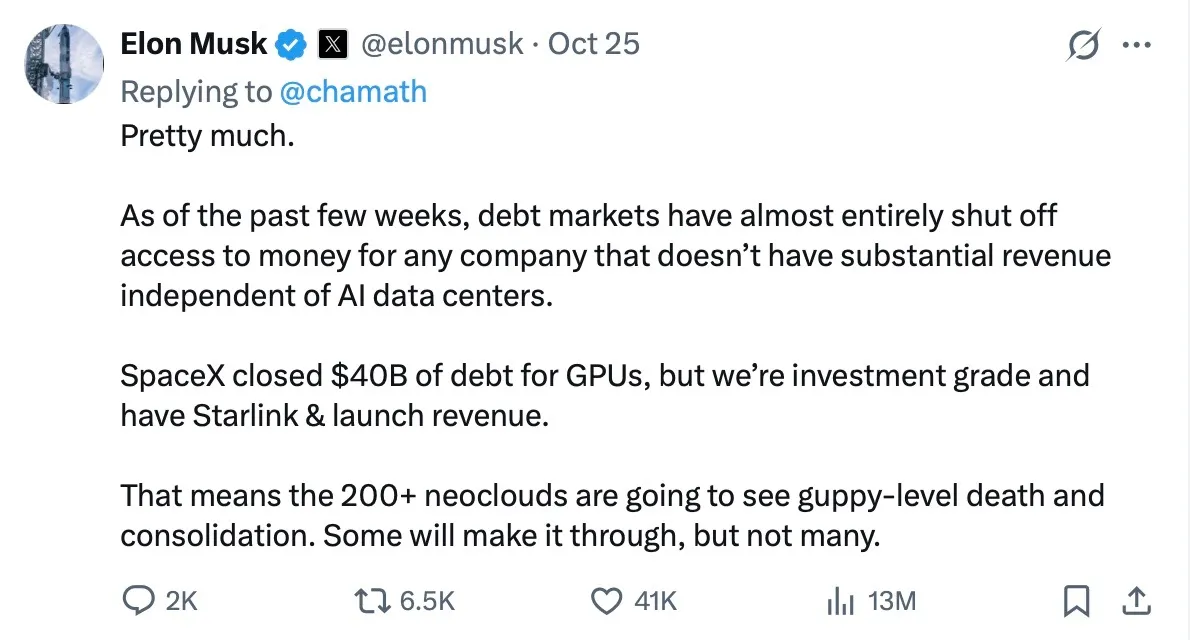
Wait, closed the financing? I thought it was “snarled”??
Well sure enough, SpaceX filed with the SEC that it signed a binding commitment with an Apollo-managed entity for roughly $40bn in GPU financing.
But here’s the structure: the Apollo-managed SPE purchases the Vera Rubin chips and the server hardware OUTRIGHT and leases them to SpaceX. It is a master financing lease agreement, with equipment delivered in batches, each corresponding to a separate 5-year lease. The lesson learned from the xAI failed sale-leaseback structure is that you can’t escape debt just by sticking an SPE in the middle. A finance lease sits on SpaceX’s balance sheet as a liability, and the rating agencies & prospective lenders treat it like debt.
What is off balance sheet is the debt issued on the other side. The SPE managed by Apollo, with the help of Goldman Sachs, now goes out and borrows secured by the chips it purchased. The cash flows underlying that debt are the lease payments from SpaceX. Like this:
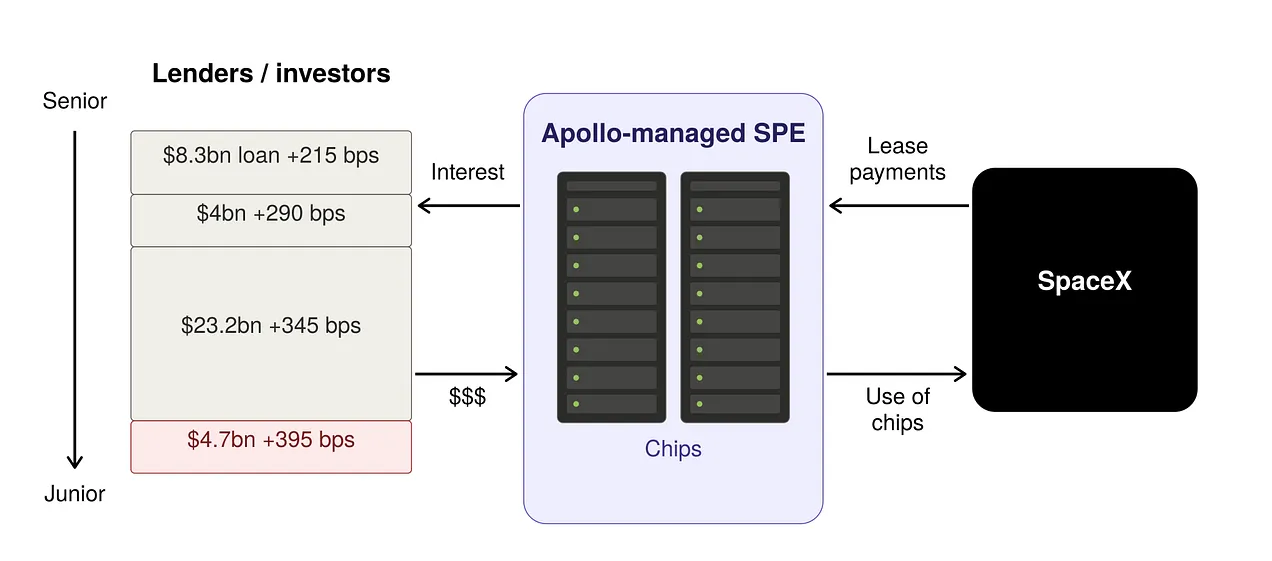
Zooming in on those spreads on the left… Rumor had it that the interest rates for this structure would be in the 7.75-8.30% range. As Apollo and Goldman are working to syndicate the SPE’s debt out to investors, spreads on some tranches look even wider:
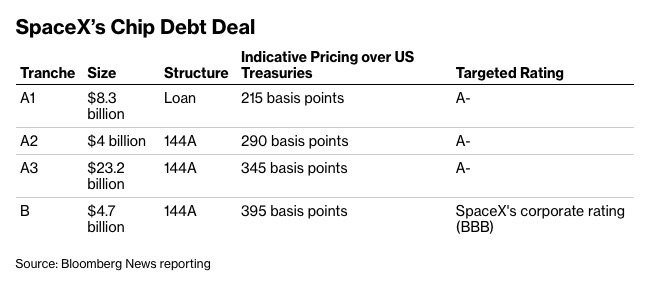
Peep that 395 bps spread on the lowest tranche, which from a creditor’s perspective represents “what’s left after everyone else got all the chips”. It’s basically just unsecured SpaceX exposure at a 5 year interest rate of 8.50-9.00%.
To me that says that SpaceX, despite its first profitable quarter since going public, and despite being an investment grade rated issuer (albeit one trading like junk), couldn’t tap the bond markets at investment grade yields.
So two conclusions:
1) If things are this hairy for a company whose 5Y CDS is trading at 271, how do you think it’s going for CoreWeave, now north of 1250?
2) The idea that SpaceX is saving Tesla by buying it is laughable. It’s the other way around.
Elon Musk literally said it himself in the tweet: any company that doesn’t have “substantial revenues independent of AI data centers” will be shut out of the debt markets. So guess what helps SpaceX, a company whose AI division constitutes more than half its revenues? Profits from a car company. The merger with Tesla would add a significant source of revenue and liquidity to the mix.
Plus, here we are, less than a week out from the Democrats sweeping the midterms. As evidenced by Thursday’s stock market crash, those were largely seen as a referendum on AI, and the outcome was not favorable.
In the midterm elections, voters rejected data centers in 40 of the 41 related measures on ballots across the country. Texas, where SpaceX has plans for its Starbase data center, now has a governor-elect who ran on a platform of freezing new data center approvals. Musk’s existing compute business and near term plans to grow it may be under considerable pressure.
And when it comes to capital, having Senator Elizabeth Warren as the likely head of the Senate Banking committee points to the doors to bank balance sheets slamming shut. The burden then falls to the private equity and private credit markets, already chock full of AI and software risk — something they are desperately trying to diversify away from as is. She’s made it a mission to crack down on those guys, too.
Not to mention, those same private capital investors are learning in real time that chip-backed financing arrangements don’t always work out as planned. Last Friday, Bloomberg reported that Microsoft had been winding down its 2023 deal to rent compute from Oracle, whose older-generation NVIDIA chips no longer fit MSFT’s needs. Hope Apollo still feels awesome about $40bn worth of chip backed financing after seeing that.
Now to be fair, SpaceX already has a large cash cushion. But its spending plans are enormous. If the debt capital markets are going to close their doors to AI financing, SpaceX could certainly benefit from additional diversified revenue sources. Enter: Tesla, who is sitting on $45bn in cash and throwing off $6bn a quarter in operating cash flow. Everyone thinks SpaceX is saving Tesla, whose metrics have deteriorated over the last few quarters. But Tesla represents a diversification and liquidity grab for a CEO realizing that the capital markets may very well turn off the spigot.
After all, the frenzy of the past few years was predicated on the idea that an endless stream of capital would always be there. Equity would always be there because AI stocks only go up. Fixed income investors would always be there; after all, the demand for IG credit STILL remains unquenched despite the gyrations of the last few weeks. And if all else fails, there’s the private capital markets, who have more money than they know what to do with chasing fewer and fewer opportunities.
In the span of the past month, SpaceX has singlehandedly tested all three of these assumptions. And the outcome points to Tesla’s cash and diversified revenue streams being all the more necessary.