

By Jen Saarbach & Kristen Kelly, Co-Founders of The Wall Street Skinny

Your Ultimate Guide to CoreWeave, AI Debt, and What Everyone is Missing
The equity markets had a collective freak out this past week about AI debt. Chamath Palihapitiya (co-host of the All In podcast) tweeted a chart showing Coreweave’s bond yields had blown out to 15%(!!!), to which Elon Musk replied “yikes!” The result? Coreweave’s stock fell 15.5% on October 14th alone, dragging the other neoclouds down alongside it. Of note, Nebius was down 10%, IREN down 12% and Oracle down 8.8%.
And the sell off wasn’t limited to equities. Coreweave and Oracle’s CDS also blew out to their widest levels, with Oracle’s now wider than where it traded in 2008.
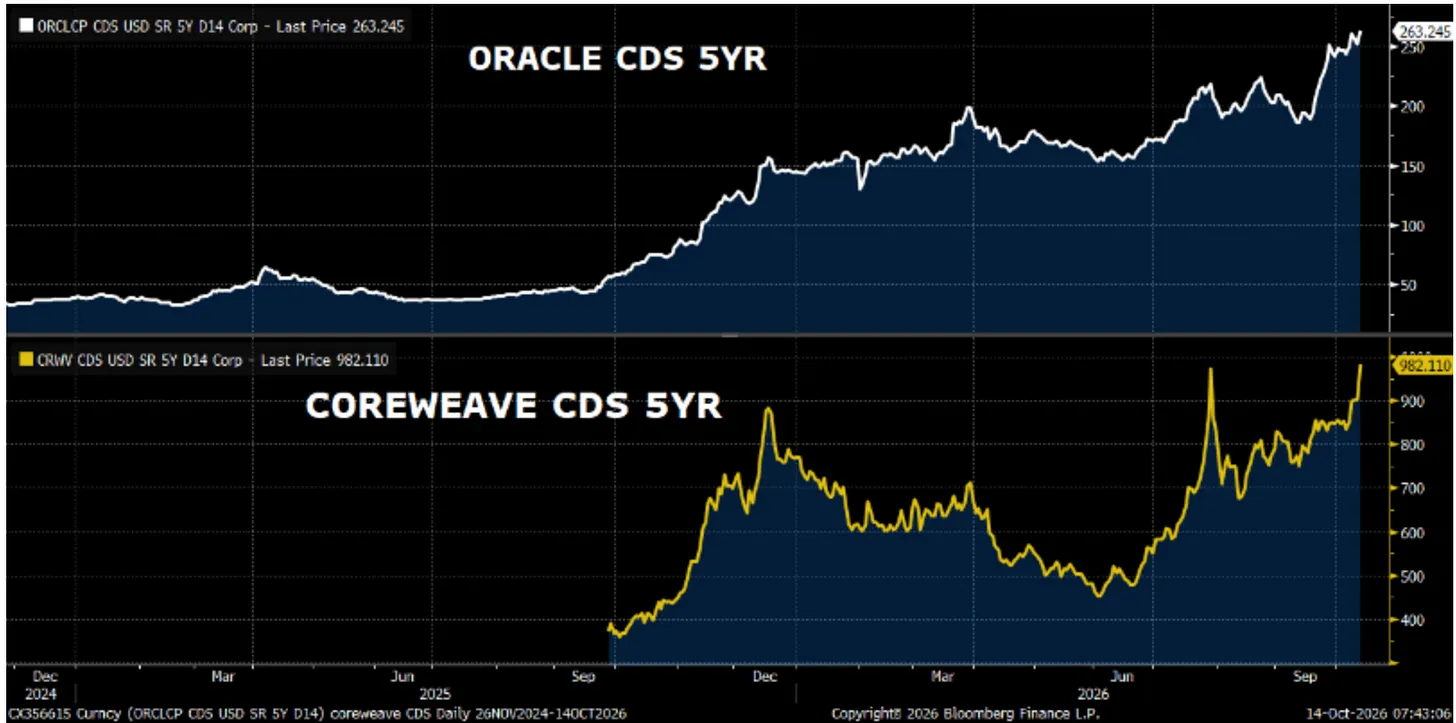
The question many are asking is: WHY?
In order to understand what’s going on, we have to dive into CoreWeave, its business model, and understand the broader category of companies called “neoclouds”.
Setting the Stage:
This article goes deep into Layer 3 of what Jensen Huang calls the “5 layer cake” of the AI ecosystem. If you need a crash course on the broader AI landscape, we’ve done numerous videos (all under 3 minutes each) on other layers, listed below:
Layer 1: Energy
Layer 2: Chips (Part 1, Part 2, Part 3)
Layer 3: Data Centers Neoclouds
Layer 4: Open vs. Closed Weight AI Models
For paid subscribers, you can access the final sketches of the drawings below.
Paid subscribers, you can access the final sketches of the drawings HERE. Please note there is a password to access the DropBox link and to open the file. The password is the word industry
Neoclouds vs. Hyperscalers
Here, we’re talking about AI infrastructure. Specifically, we’re referring to companies who sell “compute”, where compute is just the raw processing power needed to train and run AI models. Wall Street splits these companies into two categories: hyperscalers and neoclouds.
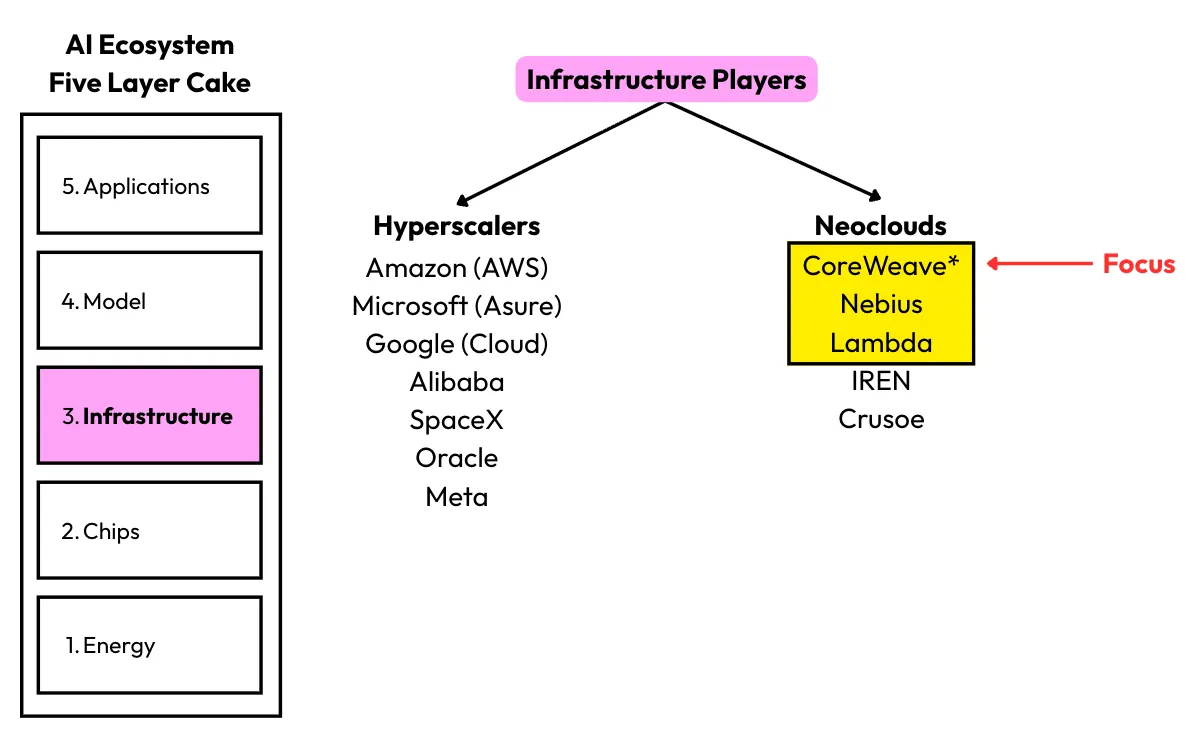
Let’s start with the hyperscalers, who in many cases already have longstanding cloud businesses. The OGs include Amazon (AWS), Microsoft (Azure), Google (Cloud), and Alibaba. Newer entrants include SpaceX, Oracle, and Meta. Some quibble about whether Meta actually belongs in the category, but since Bloomberg reported in July they’d begin selling excess compute capacity, we’ve included them. People also quibble about Oracle, which doesn’t really have any businesses outside of Layer 3, and whose insane debt burden sometimes gets it classified as a neocloud.
Most of us use Cloud services in our day to day; I personally use multiple services for storage given my laptop memory is limited. I don’t want tons of physical hard drives all over the place, so I store files on someone else’s servers and rent the time. Cloud providers make almost nothing on people like me (retail), but make a killing on their global relationships with big businesses (enterprise).
Renting storage and outsourcing servers was the original cloud business model. But AI needs something more.
Training a model and running inference isn’t about storage, it’s about processing. So cloud services geared towards AI companies are often talked about as renting time on a GPU. Renting time on someone else’s GPU (or another similarly functioning AI chip) is what we call “compute”.
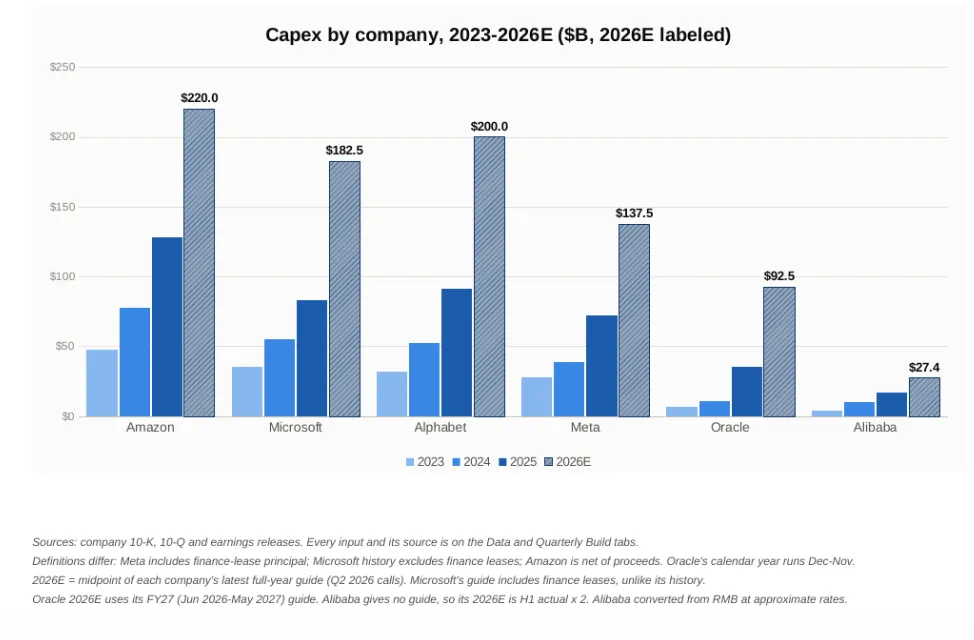
But differentiating a hyperscaler from a neocloud is less about how long you’ve been in the cloud business and more about what else you’ve got going on. The key difference: a hyperscaler has a genuinely profitable business (or businesses) subsidizing its massive CapEx. Microsoft sells Office, Amazon is the everything store, and Google and Meta sell ads. These massive earnings turn into real cash flows which – at least at first – were able to fund AI CapEx.
Recently though, CapEx has gotten so high that even hyperscalers have started raising debt. Because their existing businesses are so profitable, their leverage (Debt / EBITDA) remains low (~0.4x). But take-or-pay obligations (more on these later) do not show up in that debt number…and they don’t show up on the balance sheet, either.
Neoclouds are different. To understand this class of companies, I like using Jensen Huang’s AI Factory framing. To produce compute, you need the following “ingredients”: electricity, chips and the powered shell, which is just a building with sufficient electricity and cooling to run the chips.
Out of the AI Factory comes compute.
That framework is helpful to understand where the various “neoclouds” make money within the ecosystem.
Many neoclouds started as crypto miners, then pivoted. CoreWeave started its life as Atlantic Crypto, mining Ethereum on Nvidia GPUs. By 2019, it was already renting those GPUs out for other workloads, and rebranded as CoreWeave that same year. Then 2022 (the year of FTX’s collapse) brought the crypto winter, not to mention two of the biggest blockchains (Ethereum and Bitcoin) made mining a way less profitable business. Ethereum pretty much stopped paying miners all together; Bitcoin kept paying them but the payout halved on a fixed schedule, and the business’ expiration date loomed on the horizon.
By the end of 2022, you had a class of crypto miners who all knew the end was coming, all while sitting on all the ingredients of an AI factory.
But how they pivoted their businesses vary.
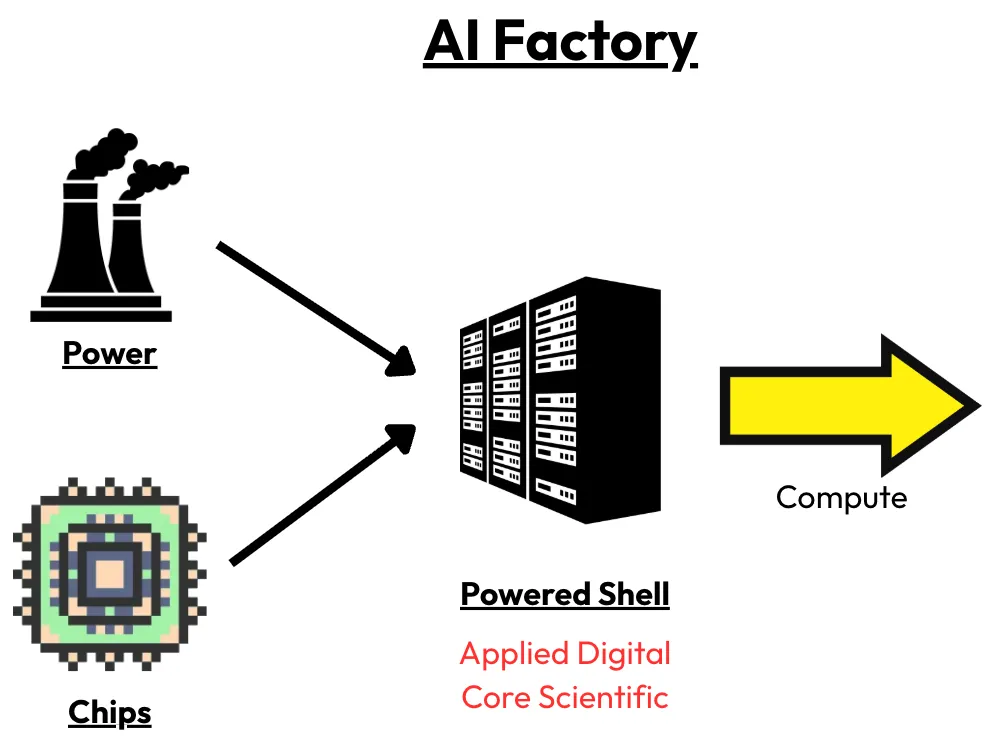
Applied Digital and Core Scientific are landlords. They own the powered shell and make money renting the real estate without taking on the risk of buying the chips. In fact, Applied Digital started out selling compute, but spun off their cloud business last year.
Of the companies who sell compute (rather than lease real estate), there are vertically integrated players like IREN who own most of its powered shells. Crusoe got there from the other direction; it started by building power and vertically integrated from there.
But CoreWeave, Nebius, and Lambda didn’t own the building or powered shells — at least, not at first. What they had was access: leases, relationships with power providers, and in some cases, contracts with large customers. What they were missing was large amounts of cash to buy chips.
Remember, chips are the largest expense in an AI data center. Per Bernstein Research, a one gigawatt AI data center costs roughly $35-40 billion all in, with GPUs alone at about 39% of the total cost. The full rack of compute hardware puts the cost closer to 60%. Additionally, the GPUs need to be replaced every ~5-6 years-ish…
That number is a huge point of contention; in the example we’ll do momentarily we’re going with 5 years because it’s the average of how long hyperscalers and neoclouds depreciate their chips in their 10Ks. Vocal investors like Michael Burry have argued it should be closer to 2-3 years, but as we’ll discuss more later.
Which brings us back to the key issue. While these companies had all the ingredients to produce compute, unlike the hyperscalers, they had neither a wildly profitable existing businesses spitting off cash flows, nor did they have the credit or lending capacity to borrow money themselves.
Enter: chip backed financing.
The Birth of Chip Backed Financing
CoreWeave’s story is interesting. Prior to 2023, it was an equity funded startup with very little debt. Then ChatGPT launched in November 2022, and suddenly every hyperscaler needed chips. What CoreWeave had that most hyperscalers didn’t was preferential access to Nvidia’s A100s and H100s. This was reportedly because, unlike Microsoft, Amazon and Google, CoreWeave wasn’t building its own chip to compete with Nvidia. So in early 2023, Microsoft signed a multi-year deal with CoreWeave — reportedly worth billions — to supply compute for OpenAI. Remember, Microsoft has a significant stake in OpenAI.
The problem was, in all of 2022, CoreWeave had only done $15.8 million of revenue. On the cash side, they’d raised about $420 million of equity. But the chips required for the Microsoft contract would cost billions they didn’t have. And the banks wouldn’t lend to a six year old former crypto miner with no track record.
Good thing you don’t only need banks to raise cash. Private credit firms got creative, taking a page from the project finance and asset-backed lending playbook. Instead of underwriting CoreWeave the company, they underwrote the contract.
CoreWeave had a take-or-pay agreement with MSFT — an AAA-rated company — for a fixed amount of compute over a fixed term. “Take-or-pay” means Microsoft owes the full payment for the reserved capacity whether they actually use it or not. To a lender, that revenue is as good as Microsoft’s credit (aka, as good as it gets; better than the US government) and CoreWeave’s ability to deliver. The lenders put that contract, along with the chips CoreWeave would buy with the loan proceeds, into a special purpose vehicle (“SPV”). They then sized the debt off the contracted cash flows, using the chips themselves as collateral.
Quick aside: Asset backed financing and project financing — one of the groups I worked on early in my career — isn’t new. What is unique about these GPU backed financings are the much shorter contract length; in the power world you often see power purchase agreements of 15-20 years and assets that have a much longer useful life (think a gas turbine). In a power deal, the debt is shorter than the PPA, and the PPA is shorter than the asset’s life, which leaves a long tail. Here the loan, the contract, and the asset useful life are much closer in length, so there is a shorter tail behind the debt.
In August 2023, Magnetar and Blackstone lent $2.3 billion on the terms of that novel structure, using Nvidia’s GPUs (H100s) as collateral. And it worked. The same lenders did it again in May 2024 for one of the largest private credit deals ever. The structure caught on, and many other neoclouds have started using it as well.
Seems great but there are limits to this structure. Those limits are why CoreWeave had to IPO (meaning go to the public equity markets to raise equity) and eventually issued corporate bonds, the same ones responsible for last week’s sell-off.
To see why, let’s walk through one example.
One Contract, One SPV
Pretend Microsoft with its AAA rating signs a 5 year contract with CoreWeave. To keep the math simple, let’s pretend that the contract says they’ll buy compute for $100 million a year.
To size the debt, you project the revenues ($100mm a year for five years), then strip out the expenses — let’s pretend those are $20 million spent on rent and energy. This leaves $80 million of cash flow to service the debt. Lenders apply a Debt Service Coverage Ratio (basically a cushion), which we’ll assume is 1.2x. So $80 million of free cash flow supports $66.7 million of debt service each year for five years.
Next, we have to figure out how eager lenders are to take on this risk — meaning, what interest rate they will charge in order to be compensated for the risk that they won’t be repaid. But remember: with this structure the lender isn’t primarily underwriting CoreWeave’s credit. Instead, they’re underwriting Microsoft; the offtaker’s rating sets a floor on the rate. What sits above that is the risk CoreWeave can’t deliver compute, and the risk the chips are worth less than the lender assumes in the event they need to seize and resell them.
The first time anyone did this type of deal, the spread was enormous: it priced at 15% even with Microsoft as the customer. By 2026 with the structure proven, similar loans priced closer to 6%. For our example let’s use 10%.
So project $66.7mm over 5 years, discount it back to today at 10%, and add it all up. That means CoreWeave can raise $252mm of debt.
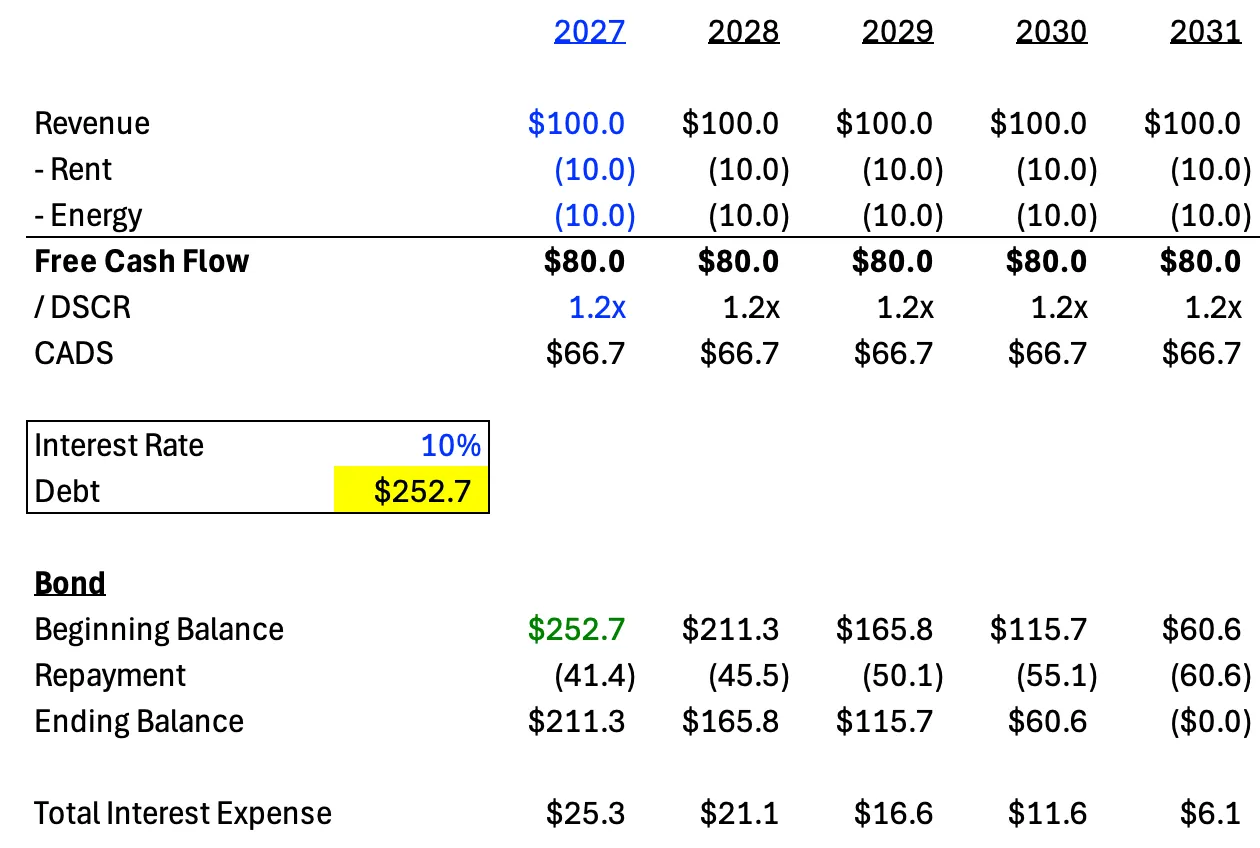
Access our simple Excel model, along with CoreWeave’s actual financials HERE. Password is industry
Now, even if the cash flows support $250 million of debt, lenders usually want CoreWeave to have skin in the game. The share they’ll lend is called the “advance rate”, and it varies with the quality of the offtaker.
For top tier offtakers like Microsoft or Meta, the advance rate can run as high as 95%, meaning if CoreWeave needed to borrow $250 million, they’d have to put up $13 million (5%) of its own cash. For a lower quality offtaker, the advance rate might be closer to 70%. In that case, to borrow $250 million, CoreWeave would have to come up with $107 million (30%). Either way, the equity slice is real money and comes from CoreWeave, not the SPV. And that’s a problem if CoreWeave isn’t generating much cash.
Let’s look at a sample income statement for that one contract. We’re assuming they are borrowing the full $250 million to buy $250 million of chips to keep things simple:
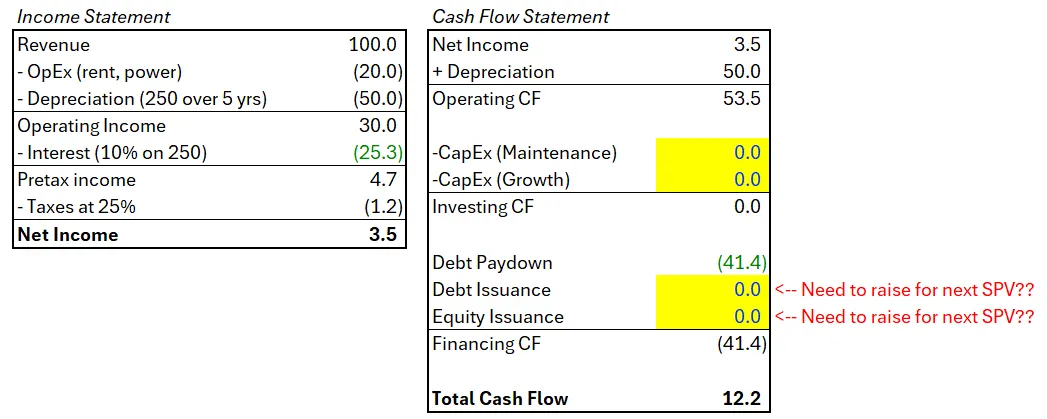
The net income is positive but barely. On the cash flow statement, you get to add back the $50mm of depreciation, so operating cash flow is $53.8mm. BUT $41.7mm is amortized, which leaves CoreWeave with $12 million — the DSCR cushion.
Over the next five projected years, on the plus side, the debt balance is declining so interest falls over that time. But there is new growth, which means more CapEx, more debt (today with rising rates), more interest etc.
And this is just one contract. The picture actually looks worse when you look at it at the company level.
Below is the company income statement scaled to a $100mm revenue for the June 2026 quarter so we can compare alongside our one SPV example.
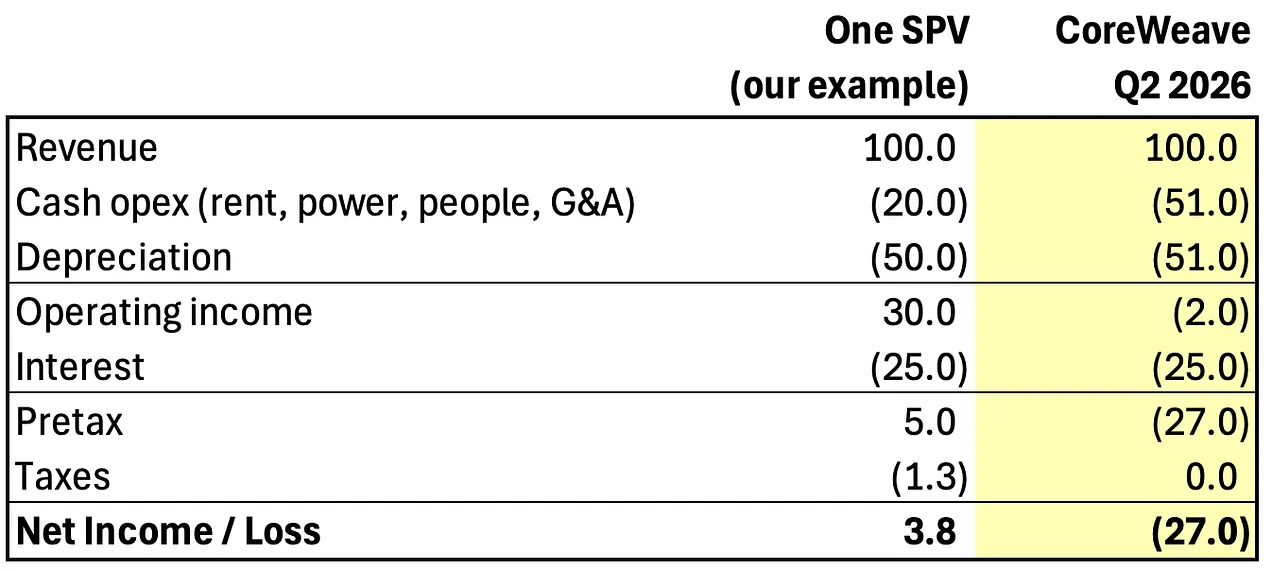
Depreciation and interest are almost exactly where our example puts them, about 50 cents and 25 cents of every revenue dollar. The difference is cash operating costs. Our SPV spends $20 because it’s simply one live contract with no overhead. The real company spends closer to 51 cents on the dollar because it’s paying rent and power on capacity that’s built but not billing, plus corporate overhead and stock-based compensation. So where the single SPV earns a sliver of net income, the company lost $626 million last quarter. It isn’t generating cash at the corporate level, and SPV debt can’t be used for anything but the chips inside that SPV.
Which means for the next deal, the leases, overhead, and growth have to be funded some other way.
The Need for More Capital
This is why CoreWeave went to the public equity markets in March 2025 in an IPO that raised $1.5 billion of much needed cash. Additionally, it gave CoreWeave access to the high yield bond market: debt with significantly fewer restrictions from investors clamoring for yield. In May 2025 it sold $2 billion of unsecured notes at 9.25% due in 2030 (the deal was 5x oversubscribed), and in July another $1.75 billion at 9% due in 2031. The use of proceeds for both was to pay down debt and start swapping 15% interest on its private credit for 9% on publicly traded bonds.
Part of what makes all this financing possible is that Nvidia is backstopping a lot of the risk. Under an agreement filed with the SEC in September 2025, Nvidia is obligated to buy up to $6.3 billion of CoreWeave’s data center capacity that isn’t used by its own customers through 2032. So if a contract rolls off today and nobody renews, Nvidia pays for that capacity. For SPV lenders, it also means that a loan against contracts with lower quality offtakers can look through to Nvidia. For corporate bondholders, it takes the worst case scenario off the table, which is a big reason why a junk rated B+ company could borrow at 9%. Nvidia also owns about 7% of CoreWeave and simultaneously books revenue when sells them chips, which is part of the circularity you see people talk about.
Regardless, CoreWeave continued to grow and raise more debt at rates that are quite low. In March 2026 they did an SPV backed by Meta contracts worth $19 billion, the first investment grade loan ever secured by GPUs. The fixed portion of the debt priced at 5.90%!!!!
All told, today CoreWeave has about $50 billion of debt and lease obligations: cheap SPV debt, leases, and some convertible debt (a topic I’ll save for another day despite it being one of my favorites).
Zooming out from our simple model…CoreWeave did $7.6 billion in revenue (on an LTM basis) but ran a 3% operating loss. LTM Operating cash flow was $6.9 billion (that’s the $53.7 million in our model, scaled up), but after CapEx was negative $13.7 billion.
Cool, thanks for the backstory…bondholders already knew all this.
Why panic now?
First: interest rates are going up. CoreWeave has a mix of floating and fixed rate debt; the SPV loans are mostly floating (so SOFR + spread), although CoreWeave hedged a third of them to fixed this year using interest rate swaps. Its lenders are also requiring them to hedge most of the newer facilities. Corporate bonds are fixed rate, so they’re safe from rising rates for now. But when CoreWeave needs to raise more fixed rate debt in the future, it’ll be priced as a spread to the yield on Treasuries and those yields are currently on the rise.
The Fed already raised rates once in September, and surprisingly high inflation readings last week mean they could easily hike again later this month. Yields on 5- and 10-year Treasuries are over 100 basis points higher than they were a year ago.
CoreWeave funds itself at a spread to Treasuries, and when it comes to that spread, the market is starting to demand more and more. As measured by their 5 year CDS (effectively, insurance contracts on their bonds), CoreWeave’s spreads went from about 450bps when they priced their 9.25% notes in May 2025 to over 1,100bps as of time of writing — implying a 76% cumulative chance of default by 2031 using a 60% recovery rate assumption.
Meanwhile, on October 9th, Firmus Technologies, another neocloud, pulled what would have been Australia’s largest IPO in 30 years.
Firmus also has a 7% Nvidia ownership, 6% Blackstone ownership, and OpenAI is the anchor customer for a number of its sites. It was seeking a $43 billion market value with only 46 megawatts operating against 3.2 gigawatts planned. But when the book opened October 6th and by October 9th, there wasn’t enough demand for the IPO to proceed. One analyst put its valuation below $10 billion. Now, it probably didn’t help matters that the Firmus co-CEO served a year in prison for insider trading.
A week earlier, Lambda (also Nvidia-backed), carrying a $50 billion backlog that is 70% contracted to Anthropic, pushed its own IPO to 2027. They went to the private markets for $4 billion instead. And finally, Wednesday October 14th, Gartner, a major tech research firm, predicted that more than 80% of neoclouds will cease operating independently by 2030, warning that over $3.5 trillion of AI infrastructure spending could face write downs because the revenue to justify it isn’t coming fast enough.
The combination of lots of negative news AND the threat of rising rates makes being an equity riskier.
Remember, every new SPV needs an equity slice from CoreWeave. When rates rise, the amount of debt you can raise raise at the SPV level goes down, so if the chips cost stays flat, the equity they have to put in goes up. If previously the $63 million of five year cash flows supported $252 million borrowed at a 10% interest rate, it only supports $223 million at a 15% rate. That’s $29 million less you can borrow so you need $29mm equity hole to plug.
Now that equity slice does’t have to come from equity raised by CoreWeave. If CoreWeave had positive cashflows they could use that, but since they don’t, that cash must come from financing — meaning, from equity, debt, or converts. Problem is, debt is getting more expensive and issuing new equity to plug the same hole gets more and more dilutive with the stock price dropping.
Regardless, CoreWeave filed an at-the-market program (“ATM”) to sell up to 35 million shares of its equity when needed. An ATM means its banks can sell shares of stock into the open market in small batches at whatever price the stock is trading at that day when the company chooses. It’s a cap, not a commitment, but when shares were $93 it would have supported $3.3 billion of equity. At $63, it only supports $2.2 billion, so say “goodbye” to a billion dollars worth of chips.
Now with all this being said, what is the risk CoreWeave may not be able to pay their debts? What’s the real risk of default? And how much is this panic overwrought?
The bull case:
Let’s start with demand. On the revenue side, much of their projected revenues are locked in for some time, given the multi-year nature of their