

By Jen Saarbach & Kristen Kelly, Co-Founders of The Wall Street Skinny
Plus the Insane Math Behind WBD CEO’s Almost $1 Billion Payout.
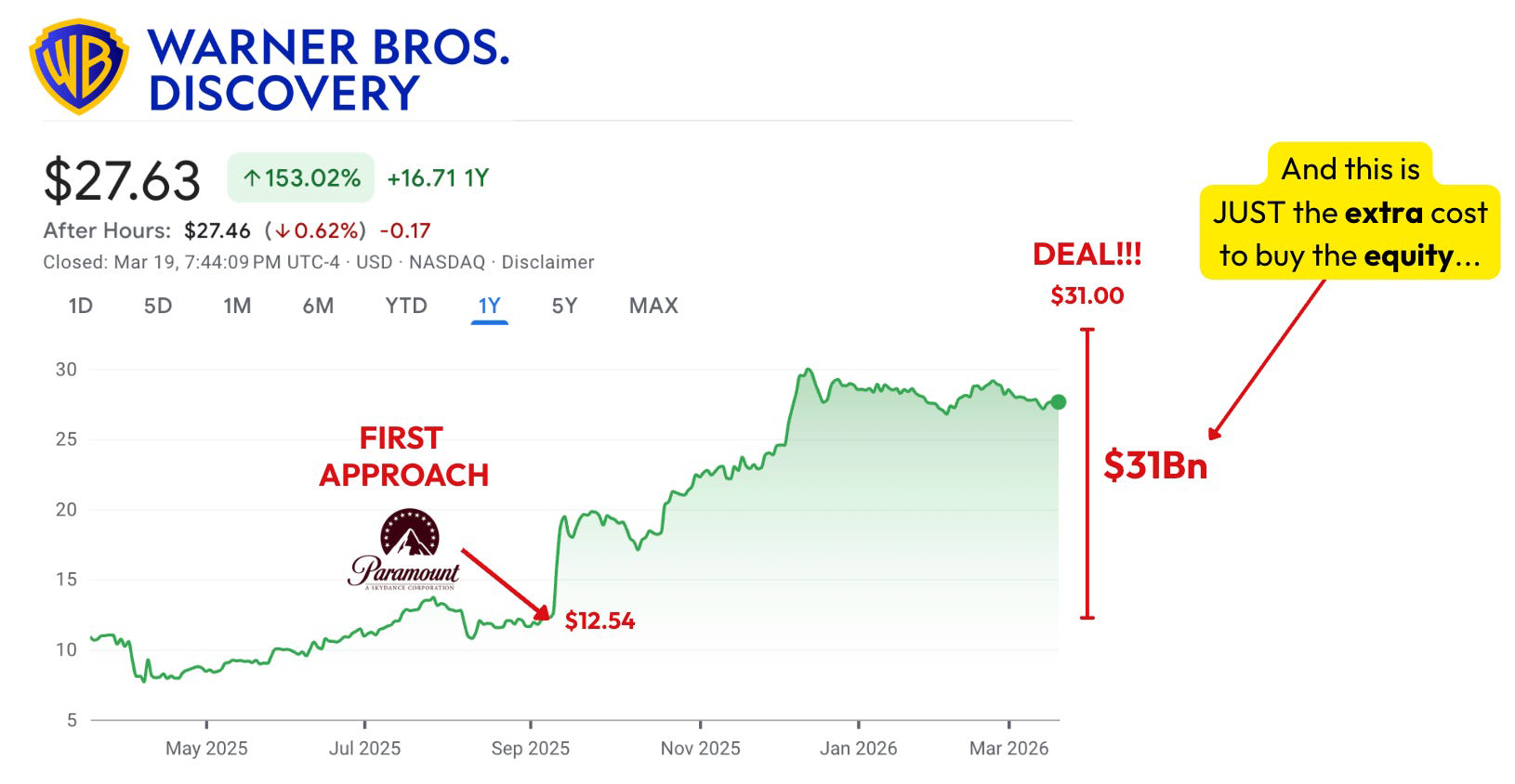
If you’ve been following our coverage, you know the story by now. The Ellisons are doing what amounts to the largest leveraged buyout in history. Paramount, a $25 billion company, is acquiring Warner Bros for $110 billion. But the final offer price of $31 per share is about 147% more than the $12.54 unaffected share price on the day Paramount CEO David Ellison first approached Warner Bros about a deal (September 2025) and about 63% more than the $19 Paramount initially offered.
Worth also noting, WBD had gotten as low as $7.52 April 2025, so less than a year ago.
Warner Bros CEO, David Zaslav rejected that initial $19 bid. Paramount upped it to $22; he said no again. They raised it to $23.50; still no. And rather than accept any of them, he did what any CEO probably should — he ran a formal auction, bringing in Netflix, Comcast, and Paramount to create a bidding war.
In the final rounds, Netflix offered $27.75 for the studios and streaming business, as did Comcast. Only Paramount bid for the whole company, offering $30 a share. Warner Bros ultimately chose Netflix and signed a deal. There were clearly a lot of hurt feelings — Paramount went hostile and even sued WBD — but ultimately WBD reopened negotiations and Paramount.
NINE BIDS after the first approach, Paramount won with a revised $31 offer. And then some…which we’ll get to.
All told, that $12 per share increase from Paramount’s first bid to the final price, across ~2.6 billion fully diluted shares, is roughly $31 billion the Ellisons and their investor group had to put up.
And that’s just the INCREMENTAL price to buy the equity. The total offer value comes out to $81 billion, not to mention what they have to raise to refinance the debt.
But ON TOP OF THAT are the extra fees.
- Because WBD first signed a deal with Netflix, WBD owed Netflix if they walked away from the transaction — $2.8 billion to be exact, and Paramount is covering that termination fee.
- They agreed to a quarterly ticking fee of $0.25 per share if the deal drags past September which will cost them $650mm per quarter.
- They agreed to a $7 billion breakup fee themselves if the merger doesn’t clear antitrust review.
AND ON TOP OF THAT is one more cost. The WSJ reported HERE that Paramount agreed to cover “a last minute” tax penalty for Zaslav himself, that at first glance looks like a ~$100 million bill, but by the time the accountants are done, that number balloons to $335 million. Here’s why.
The Golden Parachute Tax
According to a Warner Bros securities filing, Zaslav stands to collect something like $887 million when the deal closes. That number includes cash, stock options, restricted stock, and — critically — a $335 million tax reimbursement that is the subject of this entire newsletter.
That $335 million exists because of something called the “golden parachute” tax — and the company’s decision to cover it is both wildly expensive and increasingly rare.
The golden parachute tax has been around since 1984 and says when a C-suite executive gets a massive payout triggered by an M&A deal, Section 280G of the tax code says: if your total payout exceeds three times your base compensation, you owe a 20% excise tax on everything above that threshold. This is on top of all of the other taxes the executive has to pay. It’s the government saying: we see you getting a windfall from this deal, and we’re going to penalize you for it.
This triggers in M&A deals all the time. It’s not unusual. What is unusual these days is the company agreeing to pick up the tab. Back in 2005, about 51% of the largest public companies had provisions baked into their CEO’s employment agreements to cover this tax in the event of a sale — to “gross them up.” But shareholder advisory firms like ISS and Glass Lewis hammered the practice for years, and by 2016, only about 6% of large-cap companies still offered gross-ups.
Why the backlash? A few reasons.
First, the cost multiplier is insane. As we’ll walk through in detail below, every $1 of excise tax costs the company roughly 2.50–3.50 to gross up.
On a $100 million excise tax, the company is writing a $335 million check. That’s shareholder money being used to cover an executive’s personal tax bill — at a 3x markup.
Second, there’s a much simpler alternative. Instead of grossing up, the company can just cut back the executive’s parachute payments to stay below the 3x threshold — what’s known as the “best net” approach. The CEO takes home slightly less, but the company saves hundreds of millions. Proxy advisors argued this was the obvious move: structure the comp to avoid triggering the penalty in the first place, rather than paying a 3x premium to reimburse it after the fact.
Third, the gross-up completely defeats the purpose of the tax. The golden parachute penalty was designed by Congress to discourage excessive payouts. If the CEO knows the company will cover the excise tax no matter what, there’s no incentive to negotiate comp that stays below the threshold. The government created the penalty to say “this is too much.” The gross-up says “we don’t care.”
And fourth — the optics. It’s a company using shareholder money to pay a CEO’s personal tax penalty that was specifically created because Congress thought the payout was excessive. That’s a rough sell in any proxy filing.
So most companies eliminated them and publicly pledged never to bring them back. It became a standard line in proxy filings: “We do not provide excise tax gross-ups.”
And yet — companies’ boards will sometimes reintroduce gross-ups when a deal is on the line.
That’s essentially what happened here. WBD’s board — not Paramount — approved the gross-up for Zaslav on March 10th. It was WBD’s board that granted the provision to their own CEO. The twist? They structured it so that Paramount bears the cost after close. So WBD’s board was generous with Paramount’s money. Their rationale? Without it, Zaslav would be at a “substantial disadvantage in terms of excise tax exposure” compared to the previously proposed Netflix deal, which wouldn’t have triggered the golden parachute rules.
Why wasn’t this tax triggered in the Netflix deal?
Netflix wasn’t buying all of WBD — they were buying only the studios and streaming business (HBO, Warner Bros. Studios, etc.). WBD shareholders would have kept equity in a remaining entity called “Discovery Global” that housed CNN, TBS, and the linear cable networks. WBD as a corporation would have continued to exist, and Zaslav likely would have continued as CEO of the remaining company.
That matters because 280G triggers on a “change in ownership or effective control” of the corporation. No change of control, no golden parachute tax. With the Paramount deal, Paramount is acquiring 100% of WBD, there’s a change of control and Zaslav is out. Every dollar of his unvested equity, severance, and deal-triggered comp becomes contingent on that change of control — which is exactly what 280G was designed to penalize.
So the board’s argument was: Zaslav would have walked away from the Netflix deal with his full $550 million and no excise tax penalty. Argument was “It’s not his fault that this deal structure triggers a penalty the other one didn’t.” So Zaslav’s team effectively said, if you want me to take this deal over Netflix, you’re covering the tax bill…and Paramount agreed.
So how does a ~$100 million tax become a $335 million bill?
For Zaslav, the base amount — essentially his average annual compensation over the prior five years — is likely in the range of $30 million. The 3x threshold is therefore roughly 90million.Hisdeal-triggeredpayoutis~550 million, which blows past.
But here’s the key point: the 3x is just the on/off switch. Once you’re over it, the 20% excise tax doesn’t just apply to the amount above $90 million — it applies to everything above 1x the base amount. So it’s 20% on roughly 520million(550M minus the $30M base amount), which gets you to approximately $104 million in excise tax. That’s the initial bill Paramount agreed to cover.
It sounds straightforward, but it’s not.
The Gross-Up: Where the Math Gets Circular
Here’s the problem. When you reimburse someone for their taxes, that reimbursement is also income. Which means he owes income tax AND excise tax on the reimbursement. So then you have to reimburse him again. And that reimbursement is taxable too. And so on. Compensation consultants have found that it costs the acquirer roughly $2.50 to $3.50 to gross up every $1 of excise tax. Here’s why.
Let’s walk through it. (Bankers — make sure you’ve turned on iterative calculations in Excel.)
The starting point: Zaslav’s initial excise tax bill is roughly $110 million (using $110 vs. $104 because slightly simpler math).
Layer 1: Paramount reimburses Zaslav $110 million to cover it. But that 110millionisitselfincome.Soheowes~55%inregularincometaxes(federal+NYState+NYC+Medicare)=~61 million, plus 20% in excise tax = ~22million.Totalnewtaxbill:~83 million.
Layer 2: Paramount reimburses him 83million.Butthat’staxabletoo:~55%incometax=~46 million, 20% excise tax = ~17million.Newtaxbill:~63 million.
Layer 3: Paramount reimburses him 63million.~55%incometax=~35 million, 20% excise tax = ~13million.Newtaxbill:~48 million.
You see the pattern. Each layer generates roughly 75 cents of new tax liability for every dollar of reimbursement. The series converges — each round is smaller than the last — but it takes a lot of rounds before it gets to zero.
When you run it all the way out (or, you know, use the formula: Gross-Up = Initial Excise Tax ÷ (1 – 0.75) = Initial Excise Tax × 4), you land in the ballpark of $335 million. Which lines up almost exactly with what the filing discloses.
This is how Paramount agreed to cover a ~$100 million tax and ended up on the hook for $335 million. Every single dollar of that flows from Paramount’s balance sheet to the IRS and New York State.
The gross-up means Paramount is lighting that money on fire. From their perspective anyway. For us tax payers, it’s a money in the door to the IRS so, silver lining.
The Clock Is Ticking In PSKY’s Favor…Kind of.
But here’s one final twist. That $335 million? It’s not locked in. In fact, it’s shrinking every month.
The $335.4 million figure was calculated assuming the deal closed on March 11, 2026. But the 280G excise tax only applies to payments that are contingent on the change of control. Only equity that accelerates because of the deal counts. Equity that would have vested on its normal schedule regardless of whether a deal happened does not.
So as time passes, more of Zaslav’s options and restricted stock vest in the ordinary course. Every month that goes by, those shares move from the “triggered by the deal” bucket to the “would have vested anyway” bucket. That shrinks the total parachute payments.
And here’s the critical thing: 280G is a cliff, not a sliding scale. If your total parachute payments are $1 below the 3x threshold — zero excise tax. One dollar above — the 20% penalty hits everything above 1x the base amount. So as natural vesting reduces the parachute payments over time, at some point they drop below the cliff, and the entire excise tax disappears. WBD’s own outside tax advisers have estimated that if the deal closes in 2027, no tax reimbursement payment would be expected to be made to Zaslav at all. The entire $335 million goes to zero.
Paramount expects to close in Q3 2026, which means the excise tax likely still applies — but it’ll be meaningfully smaller than the $335 million headline.
BUT…there are two clocks ticking in opposite directions. Every quarter the deal drags past September, Paramount owes WBD shareholders an additional $0.25 per share in ticking fees — roughly $650 million per quarter. That clock is running against Paramount. But every month that passes, more of Zaslav’s equity vests naturally, the golden parachute calculation shrinks, and the gross-up bill drops. That clock is running in Paramount’s favor.
Paramount is simultaneously paying more to shareholders for the delay — and paying less to the government on the gross-up. At the end of the day they’ll be paying one fee or the other. If the deal closes earlier US tax payers get the money. Otherwise it’s Warner Bros shareholders.