

By Jen Saarbach & Kristen Kelly, Co-Founders of The Wall Street Skinny
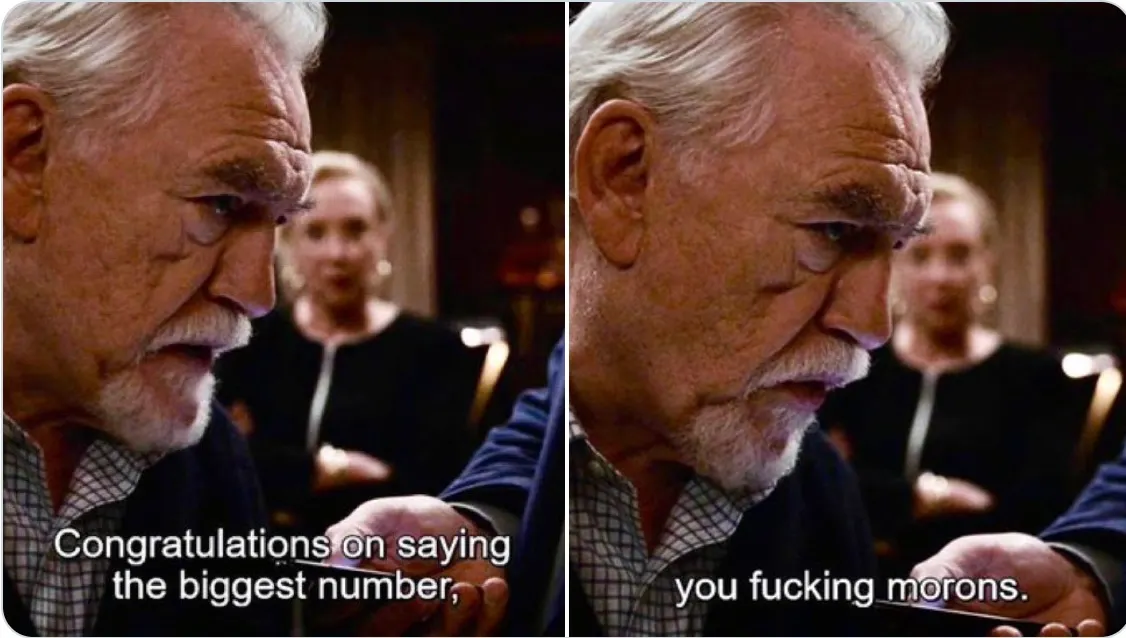
Netflix to Paramount: “Congratulations on Saying the Biggest Number, You F***ing Morons”
Any M&A banker understands why Netflix walked despite only $1 separating their losing bid from Paramount’s winning bid. WHY?
WHY didn’t Netflix counter when they seemed to be in it to win it?
WHY were Netflix shareholders so happy when Netflix walked away?
And even more interesting: WHY could Paramount “afford” to pay more than Netflix when PSKY is only a tiny fraction of NFLX’s size?
But before we get there, let’s go through a timeline.
Timeline
On September 10, 2025 – before any of this started – WBD was trading at just $12.54 per share, having been as low as $7.52 earlier that year. In M&A we call that the “unaffected share price.” The market saw WBD for what it was: a declining, over-levered media conglomerate with $33+ billion of debt and no clear path forward. Keep that $12.54 number in your head, because it’s the baseline against which every bid needs to be measured.
We need to do a quick explainer of how WBD got here because it’s important for later when we talk about their expected earnings.
How Did WBD Get Here?
Now, I’m NOT going to start in 2001 with the AOL–Time Warner merger, which I have used for years when teaching M&A as one of the worst deals of all time – a deal that literally created and then destroyed $100 billion of value in the form of goodwill.
Instead, let’s start in 2016.
To understand why WBD was trading at $12 despite owning HBO, Warner Bros. Studios, DC Comics, and Harry Potter, you need to go back to that year when AT&T bought Time Warner. They paid 85BinEquity(~108B Enterprise value when including the debt), aiming to combine distribution with premium content. Instead, the company ended up with nearly $180B pro forma of debt and limited synergies (cost savings / revenue upside). In 2021, AT&T “spun off” WarnerMedia and merged it with Discovery via a Reverse Morris Trust or RMT (another topic for another day). Warner Bros. Discovery (WBD) began trading on April 11, 2022, with its stock opening at $24.08 and closing at $26.85.
WBD CEO David Zaslav then went into aggressive deleveraging mode. While debt has since come down materially, the market punished the stock. It bottomed out at $7.52, and was trading at that $12.54 when PSKY first approached.
These mergers are also why, as we’ll see later, WBD’s reported GAAP earnings are so distorted. The purchase accounting from the AT&T merger created billions in amortization that many analysts adjust for. We will later use the “adjusted EPS” when calculating our relative PEs.
Adjusted EPS = EPS + D&A from Purchase Accounting
September 2025: Paramount Skydance CEO David Ellison (son of Larry Ellison, billionaire founder of Oracle) visited Zaslav’s home to propose a $19.00 per share cash / stock bid (60% cash). That’s a 51% premium to the unaffected price; for context your average control premium is ~20%-40%. Zaslav said “no”. Ellison came back at $22.00 per share (67% cash) with a $2 billion regulatory breakup fee and an offer for Zaslav to stay as co-CEO. Zaslav said “no” again. A third offer in October hit $23.50 (80% cash). Still no.
Rather than accept any of these offers, Zaslav decided to run a formal auction process, bringing in sell-side bankers and soliciting bids from a wider pool of buyers.
November 2025: WBD weighed offers from Netflix, Paramount, and Comcast. A crucial distinction emerged. Netflix and Comcast were only interested in the studio and streaming assets (i.e., HBO, Warner Bros. Studios, HBO Max). They did not want the declining linear cable business (CNN, TBS, TNT, etc.). Paramount, by contrast, was bidding for the whole company. Paramount’s formal auction bid was $25.50 per share for everything, but it was rejected as inadequate.
December 5, 2025: Final Bids: Netflix offered $27.75 per share for the streaming and studio assets, leaving WBD shareholders with the cable assets via a spinoff called Discovery Global. The bid was a mix of cash (23.25)andNetflixstock(4.50), with a collar to protect WBD shareholders against NFLX stock movement (watch our explanation on the collar HERE). Paramount’s final bid was $30.00 per share for the whole company. Now before we go further, it’s worth noting:
You Can’t Compare $27.75 to $30
The WBD board rejected Paramount’s $30 bid and chose Netflix at $27.75. On the surface, that looks insane. But the two offers were for fundamentally different things. Netflix was buying only the studio and streaming assets. WBD shareholders would keep the cable business through the Discovery Global spinoff. So to compare the bids, you have to ask: what are those cable assets worth?
Netflix: $27.75/share for studio + streaming, plus shareholders keep the cable spinoff
Paramount: $30/share for the entire company (studio + streaming + cable)
WBD’s board valued the cable business at roughly $3–4 per share. That meant Netflix’s $27.75 offer “grossed up” to something like $31–32 when you included the spinoff value. By this math, the Netflix deal was actually superior. Paramount argued the cable assets were worth far less – maybe 1pershare–makingNetflix’sgrossed-upofferonly~28.75. Research analysts threw out numbers ranging from $1 to $5 per share, with some joking that the cable assets had negative value.
Regardless, WBD rejected Paramount and signed a merger agreement with Netflix, selling the streaming and studio business for $27.75 in the mix of cash and stock. (You can watch our video explainer HERE.)
December 8, 2025: Paramount went hostile. In finance, “going hostile” means bypassing the target’s board and taking your offer directly to shareholders through a tender offer and a public pressure campaign. Paramount launched an all-cash tender offer at $30 per share for the entirety of WBD. Worth also noting this was essentially a hostile LBO. Again, our video breakdown is HERE.
January–February 2026: Over the course of the next few months, Netflix’s stock price was eroding, which meant the original $27.75 was deteriorating. (Review HERE.) Therefore, to keep the headline number of $27.75 and speed up regulatory approval, Netflix amended its offer to all-cash (from the original cash/stock mix) and paused its share buyback program to fund the deal.
Paramount offered to add a Ticking Fee (see explanation below), but didn’t actually raise the offer price from $30. WBD’s board therefore repeatedly rebuffed Paramount and continued to recommend the Netflix deal to shareholders.
February 24, 2026: After obtaining a limited waiver from Netflix, WBD reopened talks with Paramount, and raised its bid to $31 per share with sweeteners:
Ticking Fee: 0.25pershareforeveryquarterthedealhasn’tclosedafterSeptember30,2026(~650 million per quarter). The effective offer price ticks up from $31 to $31.25 to $31.50 with each quarter of delay, which may very well happen given antitrust hurdles.
$2.8 billion Netflix termination fee: Paramount agreed to fund the breakup fee WBD would owe Netflix for walking away from their signed agreement.
$7 billion regulatory breakup fee: If the deal fails due to regulatory issues, Paramount pays WBD $7 billion – nearly triple the breakup fee in the original Netflix deal.
February 26, 2026: WBD’s board declared Paramount’s revised offer a “superior proposal.” Netflix had four business days to match. Less than two hours later, Netflix walked away, saying “the new price would have made the deal no longer financially attractive”.
Let’s break down what they mean.
A Lesson in Accretion, Dilution, and Relative P/Es
Let’s talk about how public-company acquirers typically evaluate deals. It starts with a concept called accretion/dilution.
Accretion/Dilution: The Core M&A Test
When a public company acquires another company, they ask: will this deal increase or decrease our Earnings Per Share (EPS)? The reason for this focus is most companies’ stock price trades off EPS, meaning if EPS goes up, the share price will go up.
The formula to calculate pro forma EPS “PF EPS” is as follows: (graphic from our M&A course, and even better FREE PREVIEW of this lesson)

NOTE: As a standalone company, the buyer’s EPS is Acquiror NI / Acquiror Shares (in red).
Post deal, a few things happen. First, the buyer will pick up all the net income from the target “Target NI.”
If you pay with stock, you issue new shares, which means you get “New Shares” in the denominator, which means your EPS goes down. If you pay with cash funded by debt, you’re taking on new interest expense, which reduces net income in the numerator. Either way, there’s a cost to acquiring those earnings.
The other two adjustments are Synergies – cost cuts from eliminating redundancies, revenue upside from combining operations – and the incremental D&A from purchase accounting. In practice, “synergies” mostly means layoffs and eliminating duplicate functions, and those take time to realize. Revenue synergies are speculative and harder to bank on, so often are NOT included in this equation.
To run this accretion / dilution analysis, you need a full-blown Excel model or these days maybe just an LLM, which is fine. However, there is a quick back-of-the-envelope shortcut you can do without any computer to quickly evaluate a deal, and that is to use “Relative P/Es.”
The Relative P/E Framework
The relative P/E test comes down to comparing two numbers:
Compare (1) Buyer’s P/E to (2) the Offer P/E, where Offer P/E = Offer Price / EPS (target).
Let’s walk through it.
Step 1: Look at Deal Consideration and Determine Buyer’s P/E
Netflix had two options for funding the deal: stock or cash. The stock P/E calculation would be simple…it’s literally Netflix’s P/E. However, this deal was being done as all cash, which means we DO NOT use Netflix’s stock P/E but rather their P/E of Cash.
As a reminder, when you fund an acquisition with Cash raised through Debt, the “cost” is the interest rate you’re paying to borrow the money. We calculate P/E of Cash by taking the inverse of the after-tax borrowing rate. If Netflix is borrowing at roughly 5–6% (a reasonable assumption for investment-grade corporate debt, with the 10-year Treasury around 4%), the after-tax cost is somewhere around 4–4.5% (assuming a ~25% tax rate). Invert that:
P/E of Cash = 1 / after-tax cost of debt = 1 / ~4.25% ≈ 23–25x
This is the breakeven. If you’re paying with cash (debt), you’re effectively “buying earnings” at a ~24x multiple. Any target earnings you acquire at a P/E below 24x are accretive. Anything above 24x is dilutive.
Step 2: What is the Offer P/E for WBD?
Now one minor caveat: this is a little simplistic. Netflix was not offering $31 a share; they were offering $27.75 for only a portion of the business. BUT since we don’t have the details from the financials to break out the EPS associated with just that, we will use Paramount’s bid to look at the math, since Netflix would need to be better (read more dilutive).
Offer PE = Offer price / Expected WBD EPS.
Offer Price = $31.
WBD EPS: We want forward EPS here – what analysts expect WBD to earn next year, not what it earned last year. This is where the WBD backstory becomes critical.
The 2026 consensus GAAP EPS estimate across 24 Wall Street analysts is just $0.02 per share – effectively zero – with a staggering range from –0.61to+1.07 (24 analysts). That enormous spread tells you analysts can’t even agree on whether WBD will be profitable next year on a GAAP basis.
So if we use 2026E Consensus GAAP EPS of $0.02, Offer P/E = $31 ÷ $0.02 = ~1,550x — literally off the charts
As a sanity check, WBD just reported FY2025 actual results two days ago: GAAP net income of $727 million on 2.48 billion shares, or about $0.29 per share. Even using trailing actuals instead of forward estimates, $31 ÷ $0.29 = ~107x. On a GAAP basis, this deal is catastrophically dilutive no matter how you slice it.
But wait – this is where the purchase accounting we flagged earlier comes back. That $0.02 forward GAAP EPS is deeply misleading. The reason WBD can generate $8.7 billion in Adjusted EBITDA and $3.1 billion in free cash flow while reporting essentially zero net income comes down to one thing: purchase accounting from the 2022 AT&T–Discovery merger.
Why GAAP EPS is “Misleading”: A Quick Normalization Lesson
When AT&T spun off WarnerMedia and merged it with Discovery in 2022, all of WBD’s intangible assets – content libraries, trademarks, customer relationships, franchise rights (think: HBO, Harry Potter, DC) – were “stepped up” to fair market value under purchase accounting rules. That’s required by GAAP. The problem is that those stepped-up intangible assets then get amortized through the income statement over their estimated useful lives as a non-cash expense. It’s a real accounting charge, but it doesn’t represent any actual cash going out the door. It’s just the purchase price being expensed over time. (We get into all this in our M&A self study).
In FY2025, WBD disclosed $5.8 billion in pre-tax acquisition-related amortization of intangibles, content fair value step-up, and restructuring charges. That is an enormous number – it’s roughly 8x the company’s reported net income. It’s the single biggest reason WBD’s GAAP earnings look so low despite the business generating real cash flow. And analysts expect similar charges to persist into 2026.
To get to “normalized” earnings – what the business actually earns on an ongoing operational basis – you need to add back the non-cash purchase accounting charges (after tax). Here’s a rough walkthrough using 2025 actuals as a baseline:
GAAP Net Income: $727M / 2.48B shares ($0.29/share)
(+) Pre-tax acquisition-related amortization, content step-up & restructuring: $5.8B
(×) After-tax (assuming ~25% tax rate): ~$4.4B (~$1.77/share)
= Fully adjusted EPS: ~$2.06/share
But that $5.8B includes restructuring charges (layoffs, facility closures) that are real cash costs – not just non-cash amortization. Strip those out and a reasonable normalized EPS is closer to 1.00–1.75/share.
So let’s be generous and use the normalized range. At 1.00–1.75 per share of “true” forward earnings, the offer P/E on the $31 bid looks like this:
At $1.75 normalized EPS: $31 ÷ $1.75 = ~18x (accretive vs. 24x cost of cash)
At $1.00 normalized EPS: $31 ÷ $1.00 = ~31x (dilutive vs. 24x cost of cash)
At $0.02 forward GAAP EPS: $31 ÷ $0.02 = ~1,550x (hard not to laugh)
Even in the most favorable scenario – $1.75 of normalized earnings – the deal is only modestly accretive before you factor in the execution risk, integration costs, and the fact that WBD’s cable business is declining. And that’s using the high end of normalized earnings. At the midpoint, it’s dilutive. At the low end, it’s laughable. Now relative P/Es ignore synergies, but they also ignore D&A from purchase accounting (which we’ve been ignoring anyway to make look better). Regardless, you’d need significant synergies just to make the math work, with zero margin for error.
Step 3: Compare and conclude.
The rule: if the Offer P/E > the Buyer’s P/E of cash, the deal is dilutive on day one (before synergies).
P/E of Cash (Netflix’s currency): ~24x
Offer P/E (WBD at $31): ~1,550x (GAAP) or ~18–31x (normalized)
Verdict: Catastrophically dilutive on GAAP. Ranges from modestly accretive to clearly dilutive on normalized earnings, depending on your assumptions. Needs significant synergies and best-case normalization to work.
Ironically…the BEST thing NFLX could do for their stock was walk
Netflix closed at $100.24 on December 5, the day the WBD deal was announced. From there the stock fell relentlessly – dropping more than 18% by late February. At its worst, Netflix was down roughly 25% from the announcement. In dollar terms: Netflix had lost more in market cap over the life of this deal than the entire equity value of what it was offering for WBD. The accretion dilution math almost didn’t matter.
Netflix also had announced it would be suspending its share buyback program when it announced it was be shifting from a cash / stock mix to all cash, adding insult to injury.
The moment Netflix declined to match on Thursday, February 26, the stock popped nearly 10% in after-hours, then jumped again the next morning to close around $93. Netflix announced it would collect the $2.8 billion breakup fee, resume buybacks, and invest $20 billion in original content.
Netflix lost the bidding war – yet the reality is – it arguably won. And Paramount having “won” now faces the Herculean task of making it through anti-trust scrutiny, dealing with the expected 6.5x – 7x leverage on an LTM basis (this is not the “synergized” EBITDA they quote in their press release…we will get into all this in our next breakdown), with declining cable assets.
Which brings us to the Succession quote that perfectly captures this moment. In the Season 4 premiere, Logan Roy’s children outbid him for Pierce Global Media. Logan calls them and says: “Congratulations on saying the biggest number, you f***ing morons.”
Winning a bidding war isn’t the same as WINNING. Sometimes the best deal is no deal at all.
So Why Could Paramount Pay More?
If the accretion math doesn’t work for Netflix, it DEFINITELY doesn’t work for Paramount. PSKY is public and far more highly leveraged than NFLX – and to do this deal, it’s doing what amounts to the largest LBO in history (review our deep dive HERE).
Because of that risk profile, Paramount’s cost of debt is almost certainly higher than what Netflix would pay, which means its P/E of Cash is even lower than 24x – making the dilution even worse. So why is Paramount doing it? Because, despite being a public company, Paramount isn’t making this decision based on accretion/dilution math at all. It’s playing by different rules.
Paramount didn’t just want WBD – it needed it. Without WBD, Paramount remains a subscale media company slowly bleeding out in a market dominated by Amazon, Apple, and Netflix, all of which have essentially unlimited balance sheets and spend $15–20B+ annually on content. Ellison’s entire thesis for buying Paramount in the first place was consolidation – the bet that legacy media can only survive by getting bigger. WBD is the play that makes Paramount big enough to matter
What Happens Next
The Paramount–WBD deal still needs WBD shareholder approval and regulatory clearance. The DOJ has already initiated its most rigorous form of antitrust review, and Democrats in Congress have signaled opposition. The deal is expected to close between September and December 2026 – if it closes at all. Every quarter of delay costs Paramount another $650 million in ticking fees.
Meanwhile, Netflix walks away with a $2.8 billion termination fee, a clean balance sheet, plans to invest $20 billion in content this year, and a resumed share buyback program. Losing this deal may have been the best thing that could have happened for them.