

By Jen Saarbach & Kristen Kelly, Co-Founders of The Wall Street Skinny

This past week we interviewed Goldman Sachs’s Head of Alts for Wealth, Kristin Olson (interview HERE), and asked her all the cynical questions you’ve asked us with regards to expanding private markets’ access to retail investors.
She talked about how:
- Fees can be misleading on the more liquid “retail products” (evergreen and perpetual funds)
- Whether the quality of the underlying investments differ between products meant for retail investors vs. institutional investors, and gave us a list of questions to ask when diligencing a possible investment
- And most relevant to today’s conversation, she spoke about GATING
Gating means investors who put money into a fund expecting to be able to get some amount back on a pre-determined schedule, say, each quarter, get locked in. The fund “pulls up the gates”, saying they will instead return capital on their own timeline.
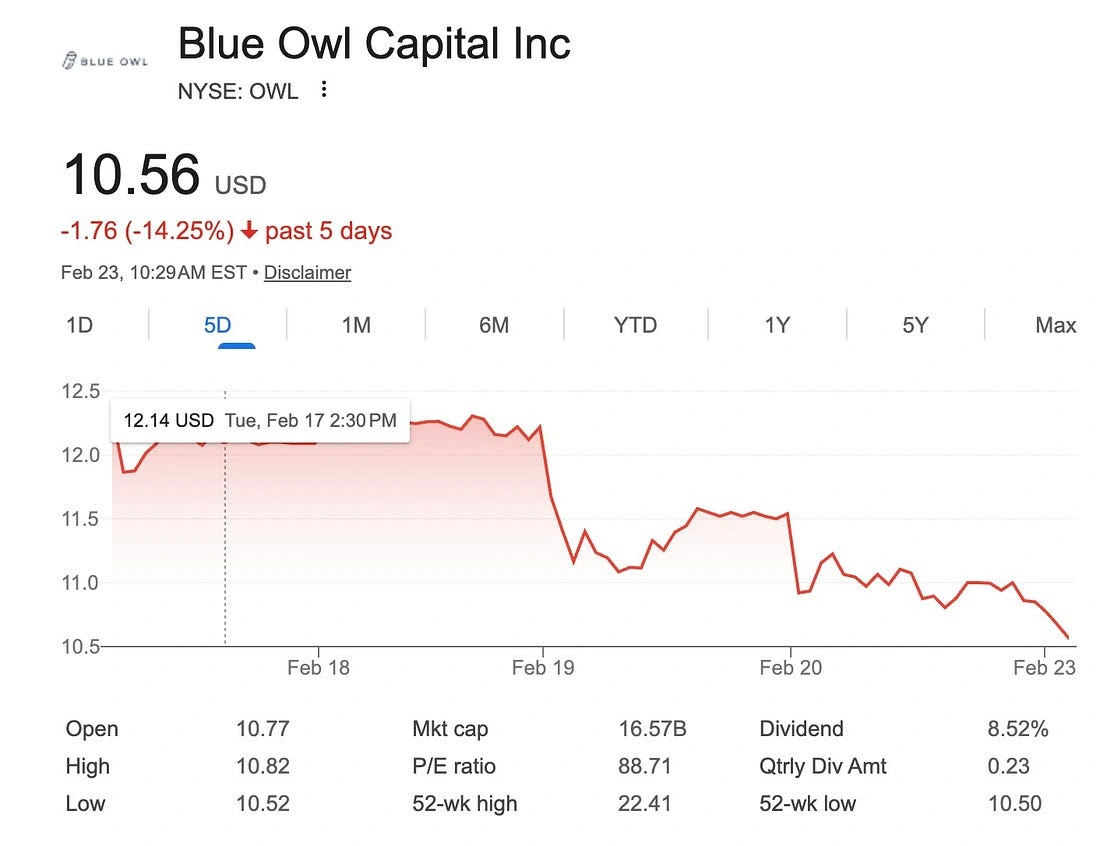
The day after we released the Kristin Olson interview, there was news that a major player in private credit, Blue Owl, had permanently shut down redemptions at its retail-focused private credit fund. The fund in question is Blue Owl Capital Corp II (OBDC II), and the story of how it got here is a cautionary tale about everything we’ve been talking about when it comes to the “democratization” of alternative investments.
So let’s break it down below.
What Is This Fund, and Who Was It For?
Blue Owl’s Private Credit Fund (OBDC II) was designed to let retail investors participate in what, over the past few years, has been perceived as the hottest asset class. But retail buyers have different needs from institutional investors like endowments and foundations who have long-term investment horizons.
“Private Credit” can come in different flavors. So if you’re investing in this debt, you could be investing in:
- Acquisition debt: you may be lending money to a private equity firm borrowing money to buy a company. For example, if a PE firm wants to buy a SaaS business for $100, they put in $30 of their own money (equity) and borrow the remaining $70. If that $70 comes from a private credit fund you’ve invested in, you’re lending that company acquisition debt as part of a Leveraged Buyout (LBO).
- There’s also project debt, something we’ve seen a lot of recently with hyperscalers trying to fund AI data centers. We saw this with Meta building Project Hyperion. They created a SPV owned 80% by Blue Owl, 20% by Meta. Blue Owl and Meta put in some of their own cash in the form of equity to build that data center and then raised debt that was backed by promised “project cash flows”, which were lease payments being made by Meta to the project.
- There’s straight-up corporate direct lending, meaning loans made to companies for general corporate purposes, and then asset backed lending, where loans are backed by assets like credit card receivables, for example.
- We have a number of primers on all this in our YouTube library linked above.
The common thread though: private credit means debt that is not publicly traded the way say corporate bonds are in the open market. These loans are not liquid, and as a result they should theoretically come with a higher return vs. publicly traded debt.
But here’s the thing.
Traditional private credit funds were historically designed for institutions. Institutions like the Harvard endowment, big pension funds like CalPERS, or the Gates Foundation who have much longer time horizons. They tend to be sophisticated and understand that if they invest money, it’s often locked up for 5-10 years due to the illiquid nature of the underlying assets. Private equity and private credit funds therefore historically used a closed-end drawdown structure for institutional investors.
The way this works is investors commit capital i.e., they “write a $250 million ticket” to a firm like Blue Owl or Blackstone. But it takes time for Blue Owl to find investments. As they find the loans they want to make, they call capital, meaning an investor like CalPERS has to wire the money, Blue Owl invests for some 7 – 10 year time frame, and eventually Blue Owl returns capital (aka gives the money back) as the loans mature or underlying companies are sold / IPO-ed (in the case of private equity). The fund has a defined life and there are no redemptions. (We’ll spare you the conversation about secondaries).
That’s fine if you’re Harvard’s Endowment. You have a 30+-year time horizon and don’t need to pull cash to buy a house or pay tuition. The illiquidity is the point; it’s the reason these investments earn a premium over liquid debt or publicly traded equity.
But retail investors often don’t have those long term investment horizons, and may want or need their money back.
Enter the “evergreen” or perpetual fund. No fixed maturity date, with a “liquidity sleeve”: quarterly redemption windows where investors can request to cash out, generally capped at about 5% of net assets per quarter.
OBDC II was this type of vehicle, and on paper, it sounds great. Private credit returns with quarterly liquidity! But as we’re about to see, that “liquidity” comes with an asterisk.
OBDC II redemptions climbed through 2025, hitting $60 million in Q3 alone, roughly 6% of net asset value, already above the typical 5% gate.
The Merger That Wasn’t
Blue Owl’s first attempt to fix this wasn’t actually through gating. Instead, they wanted to merge OBDC II into its bigger, publicly-traded sister fund, Blue Owl Capital Corporation (ticker: OBDC).
Sidebar for those who need it: What is a BDC? A Business Development Company is a publicly traded vehicle that lends to middle-market companies. BDCs trade on stock exchanges like any other stock, which means investors can buy or sell shares whenever they want, not the “quarterly redemption subject to a 5% gate”.
The idea was the publicly traded fund would merge with the evergreen fund, and suddenly retail investors would have shares they could sell on the open market!
Except…BDCs trade at market prices, and market prices don’t always match what the fund says its assets are worth. The “big sister” fund, OBDC (hypothetical acquiror) was trading at a meaningful discount to its stated NAV (net asset value) at the time. The FT reported that the evergreen fund investors would have faced a roughly 20% haircut based on the ACQUIRING FUND’S market trading price, meaning if the loans that backed their stake were worth $100, they’d be selling to the publicly listed fund for $80.
Why would something trade at a 20% discount to NAV?
This gets at the most important (and least discussed) realities of non-traded funds. There are really two things happening:
- First, NAV is an internal valuation; it’s what the fund manager says your assets are worth. Remember, it was only a few months ago we saw the First Brands and Tricolor bankruptcies, and Jamie Dimon said “when you see one cockroach there are probably others”. When the market is frothy, lenders get lax. So the first reason NAV can differ from market price is simple: the underlying loans are bad, but the asset manager hasn’t marked them to market. That’s scenario A: a real disconnect between what something is worth and what people think it’s worth
- But there’s a scenario B, and it’s one I’ve seen up close. I sat on the CLO desk at Morgan Stanley during the 2008 financial crisis, and I watched CLOs, instruments that ultimately had real value, get painted with the same brush as all CDOs and sold at fire-sale prices.
Why? Because the price of something is based on supply and demand, buyers and sellers. In 2008, people got spooked and anything with the word CDO was seen as toxic. It didn’t help that many of the same investors holding CLOs were also invested in CDOs and the ABS garbage that was genuinely bad, so investors needed liquidity wherever they could find it, and that meant dumping good assets alongside the bad ones.
And remember, that big sister fund is PUBLICLY TRADED, and public market buyers aren’t necessarily doing fundamental analysis on the loan book. Many have gotten spooked and wanted out. The market price reflects what people are willing to pay, so there can be a real disconnect between the market price and the actual underlying value of the assets.
That dynamic is partially playing out here. OBDC was able to sell a portion of their loan book, $800mm, for 99.7% of their carrying value.
As a non-expert on Blue Owl’s specific portfolio, I can’t tell you which scenario is driving the discount, whether it’s a genuine gap between stated NAV and real-world value, or whether it’s good assets getting dragged down by SaaSpocalypse panic, but it’s probably a little of both.
The SaaSpocalypse Connection
So why were redemptions climbing in the first place? A quick recap for those who read our SaaSpocalypse coverage, and some context for those who didn’t.
A huge portion of private credit activity in recent years involved lending to SaaS and software companies, often in the context of private equity buyouts (that acquisition debt example above). As a private credit lender, SaaS companies seemed low risk because these companies generate recurring subscription revenue and the cash flows are predictable.
Enter some recent advancements in AI like Claude Cowork and people are freaking out that many software subscriptions companies are buying can be replaced by AI. People are panicking about just how many years of subscriptions these companies have left before they’re replaced by AI.
But here’s where we think the market narrative is running ahead of the fundamentals.
Debt investors think about risk through leverage, specifically, Debt / EBITDA, where EBITDA is a proxy for operating cash flow. If a company has 5x leverage, it means it would take roughly five years of operating cash flow to pay down the debt. The question a lender is really asking isn’t “will AI disrupt this company eventually?” It’s: “Can this company keep making its interest payments AND pay me back my principal before that happens?” Unlike equity investors who are investing based on the expectation that a company will generate cash flows into perpetuity, lenders just need to get their interest and principal payments back in a pre-defined time frame.
And the answer, even in a world where AI poses a real competitive threat, is more nuanced than the panic suggests. As we talked about in our SaaSpocalypse piece: business model decay is usually slow, not sudden. The Yellow Pages didn’t stop printing until 2019. Switching away from enterprise software requires retraining workforces, migrating data, rebuilding integrations, and betting that the AI replacement can actually do what the legacy product does. That’s a multi-year process at best. And many of these legacy software names could end up being the biggest beneficiaries of AI if they integrate it into their existing subscription base.
Which brings us back to the key point from this story. Blue Owl sold some of their OBDC II’s loans at 99.8% of their carrying value. Pension funds and insurance companies, institutions that analyze credit risk for a living, looked at this portfolio and essentially said: these are money good and were willing to pay pretty close to par.
So you have retail investors panicking while sophisticated institutional buyers are lining up to buy a portion of those underlying loans at full price.
Why Is Gating Allowed?
Like we explained above, those quarterly redemption windows come with a mechanism called a gate. If more than 5% of investors want their money back in any given quarter, the fund doesn’t have to honor all the requests. It can’t, because the underlying assets aren’t liquid. You can’t just sell a private loan on Monday because some investors want out on Friday.
The gate is basically a pressure release valve that exists to prevent forcing a fund to liquidate good assets at fire-sale prices, destroying value for everyone, including the investors who weren’t trying to leave. And while it can make sense in theory, it really sucks when you’re the investor being gated. I have personal experience.
A few years ago, we invested in a structure like this. My husband and I are relatively sophisticated investors who understand how this works. In fact in 2022, we started seeing signs of stress so tried to get ahead of gating shenanigans by submitting a redemption request. That very month, the fund gated and what followed was utter nonsense. We had to submit written letters, with wet signatures, month after month. It was an absurdly analog, adversarial process for what should have been a straightforward transaction.
What This Means for You
We’ve been talking about this for a while now: the push toward “democratization” of alternative assets is one of the biggest themes in asset management today. And there’s real merit to the idea that retail investors should have access to strategies that have generated strong returns for institutions over decades.
In our conversation with Kristin Olson, she made the point that if the industry doesn’t execute on democratization thoughtfully, with a huge emphasis on EDUCATION, there will be problems…like we are seeing with this Blue Owl lawsuit.
Because liquidity risk is the thing that people just do not understand until it happens to them. “Quarterly redemptions subject to a 5% gate” sounds like a reasonable trade-off but it is a very different experience when you actually need your money and the door is locked.
OBDC II is not an isolated incident. It is the logical endpoint of a structure that promises liquidity on assets that are fundamentally illiquid. And as more retail money pours into these vehicles, we’re going to see more of this, not less. OBDC II is the most recent cautionary tale.
Before you invest in any semi-liquid alternative fund, ask yourself one question: Would I be OK if I couldn’t touch this money for years? Because regardless of what the redemption policy says on paper, that is the real downside scenario.